










Direkt zum Inhalt

Warenkorb

  • Anna Schober

    The Cinema Makers. Public Life and the Exhibition of…

  • von Borries, Ahlert, Fischer (Hrsg.)

    Die Berliner Weltverbesserungsmaschine. Die Rekonstruktion…

  • Friedrich von Borries, Jens-Uwe Fischer

    Die Berliner Weltverbesserungsmaschine. Die Geschichte…

  • Sven Lütticken

    History in Motion. Time in the Age of the Moving Image

  • Kevin C. Smith

    Recombo DNA. The Story of Devo, or How the 60s Became the…

  • Bastian Lange, Gottfried Prasenc,…

    Ortsentwürfe. Urbanität im 21. Jahrhundert

  • Claudia Mareis, Matthias Held, Gesche…

    Wer gestaltet die Gestaltung? Praxis, Theorie und…

  • Jean-Luc Nancy

    Äquivalenz der Katastrophen (Nach Fukushima)

  • gerade nicht auf Lager
    Rem Koolhaas, Hal Foster

    Junkspace with Running Room

  • Hilke Wagner, Axel Wieder (Eds.)

    Susanne Kriemann

  • Lionel Bovier

    Paulina Olowska. Book

  • Anri Sala

    Ravel Ravel Unravel

  • Anne Huffschmid, Kathrin Wildner (Hg.)

    Stadtforschung aus Lateinamerika: Neue urbane Szenarien.…

  • Thomas Keenan, Tirdad Zolghadr (Eds.)

    The Human Snapshot

  • gerade nicht auf Lager
    Between Artists

    Thom Andersen / William E. Jones

  • Heidrun Holzfeind

    Strictly Private

  • gerade nicht auf Lager
    Doreen Mende, Estelle Blaschke, Armin…

    Doppelte Ökonomien / Double Bound Economies

  • Bernadette Corporation

    Reena Spaulings. A Novel by Bernadette Corporation

  • IDEA Magazine

    IDEA 357. Architecture in Print: The Development of…

  • Klaus Zwerger

    Das Holz und seine Verbindungen. Traditionelle Bautechniken…

  • Abäke, Bernadette Corporation, Laurenz…

    Sonderedition Zwölf Taschen für Pro qm

  • Lucius Burckhardt

    Design ist unsichtbar. Entwurf, Gesellschaft und Pädagogik

  • Dietmar Kammerer (Hg)

    Vom Publicum. Das Öffentliche in der Kunst

  • Studienhefte Problemorientiertes Design…

    Lucius Burckhardt. Design heisst Entwurf

  • Studienhefte Problemorientiertes Design…

    Horst Rittel. Die Denkweise von Designern

  • gerade nicht auf Lager
    Gerald Raunig

    Fabriken des Wissens. Streifen und Glätten 1

  • Annette Wehrmann

    Luftschlangentexte

  • Oda Pälmke (Hg.)

    Ganz gut – Quite Good Houses

  • Mårten Spångberg

    Spangbergianism

  • Rem Koolhaas, Hans Ulrich Obrist (Hg.)

    Project Japan. An Oral History of Metabolism

  • gerade nicht auf Lager
    metroZones (Hg.)

    Urban Prayers – Neue religiöse Bewegungen in der globalen…

  • Byung-Chul Han

    Shanzhai. Dekonstruktion auf Chinesisch

  • gerade nicht auf Lager
    O.M. Ungers

    Morphologie City Metaphors

  • Bettina Allamoda

    Catwalk to History - A Sourcebook

  • Martin Ebner, Florian Zeyfang (Hg.)

    Poor Man’s Expression

  • Caleb Kelly (Hg.)

    Sound (Documents of Contemporary Art)

  • gerade nicht auf Lager
    Gwen Allen

    Artists' Magazines. An Alternative Space for Art [pb]

  • gerade nicht auf Lager
    Chris Kraus

    Where Art Belongs

  • Beatriz Colomina, Craig Buckley (Hg.)

    Clip, Stamp, Fold. The Radical Architecture of Little…

  • gerade nicht auf Lager
    Michael Merrill

    Louis Kahn. On the Thoughtful Making of Spaces

  • An Architektur

    An Architektur 23: On the Commons

  • IDEA Magazine

    IDEA 341. Dialogues with Tatsuya Ariyama

  • gerade nicht auf Lager
    Brandon LaBelle

    Acoustic Territories. Sound Culture and Everyday Life.…

  • gerade nicht auf Lager
    Adolf Opel (Hg.)

    Adolf Loos. Gesammelte Schriften

  • Pal Ahluwalia

    Out of Africa. Post-Structuralism's Colonial Roots

  • Christoph Schäfer

    Die Stadt ist unsere Fabrik. The City is Our Factory.

  • Stefan Marx

    85 Zeichnungen

  • Sandra Schaefer

    Stagings. Kabul, Film & Production of Representation

  • gerade nicht auf Lager
    Steve Goodman

    Sonic Warfare. Sound, Affect, and the Ecology of Fear

  • Gui Bonsiepe

    Entwurfskultur und Gesellschaft. Gestaltung zwischen…

  • gerade nicht auf Lager
    Claire Doherty (Hg.)

    Situation. Documents of Contemporary Art

  • Charles Harrison

    Since 1950. art and its criticism

  • gerade nicht auf Lager
    James Hennessey, Victor Papanek

    Nomadic Furniture. D-I-Y Projects that are Lightweight

  • Claire Fontaine

    Vivre, vaincre

  • Claire Fontaine

    Claire Fontaine. Vivre, Vaincre

  • Brian Holmes

    Escape the Overcode. Activist Art in the Control Society

  • IDEA Magazine

    IDEA 332. How does graphic design CHANGE?

  • Jean-Luc Godard, Youssef Ishaghpour

    Archäologie des Kinos, Gedächtnis des Jahrhunderts

  • Arkitip No. 0048

    Ryan McGinness

  • Rahel Lämmler, Michael Wagner

    Ulrich Müther. Schalenbauten in Mecklenburg-Vorpommern

  • Martina Löw

    Soziologie der Städte

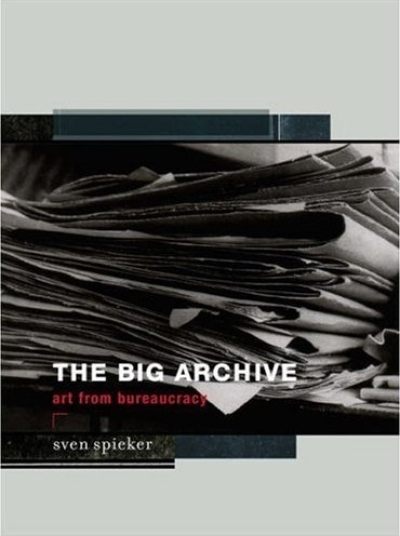
  • Sven Spieker

    The Big Archive. Art From Bureaucracy

  • Thomas Meinecke

    Jungfrau

  • Grada Kilomba

    Plantation Memories. Episodes of Everyday Racism

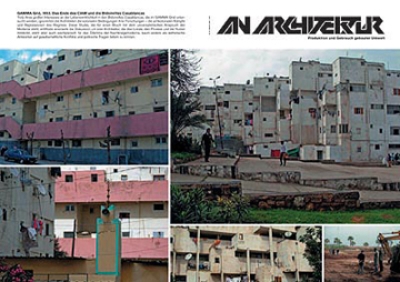
  • An Architektur

    An Architektur 22: GAMMA Grid, 1953. Das Ende des CIAM und…

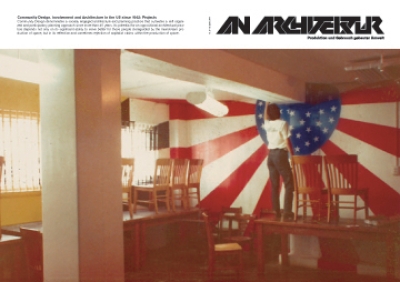
  • An Architektur

    An Architektur 19-21: Community Design. Involvement and…

  • Antonio Negri

    The Porcelain Workshop. For a New Grammar of Politics

  • Christoph Schaub, Michael Schindhelm

    Bird's Nest (DVD, 87 min.). Jacques Herzog und Pierre…

  • Laurence A. Rickels

    Ulrike Ottinger. Eine Autobiografie

  • N. John Habraken, Arnulf Lüchinger

    Die Träger und die Menschen. Das Ende des Massenwohnungsbau…

  • gerade nicht auf Lager
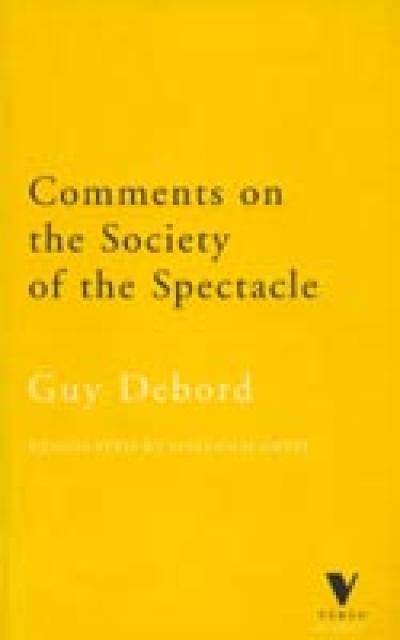
    Guy Debord

    Comments on the Society of the Spectacle

  • Michel de Certeau

    Kunst des Handelns

  • Alain Badiou

    Wofür steht der Name Sarkozy?

  • gerade nicht auf Lager
    Donna Haraway

    Die Neuerfindung der Natur. Primaten, Cyborgs und Frauen.

  • gerade nicht auf Lager
    Stefanie Schulte Strathaus, Florian…

    Wer sagt denn, dass Beton nicht brennt, hast Du’s probiert?

  • gerade nicht auf Lager
    Henri Lefebvre

    Writings on Cities

  • Loretta Napoleoni

    Rogue Economics. Capitalism's New Reality

  • AD

    AD 174. Vol. 75. Nr. 2. Samantha Hardingham. The 1970…

  • An Architektur

    An Architektur 18: Camp for Oppositional Architecture:…

  • Johan Frederik Hartle

    Der geöffnete Raum. Zur Politik der ästhetischen Form

  • An Architektur

    An Architektur 16-17

  • Vera Beyer, Jutta Voorhoeve, Anselm…

    Das Bild ist der König. Repräsentation nach Louis Marin

  • An Architektur

    An Architektur 15 / FFM 11: Europäische…

  • An Architektur

    An Architektur 14: Camp for Oppositional Architecture

  • An Architektur

    An Architektur 11-13: Theorie und Praxis der Kartografie

  • An Architektur

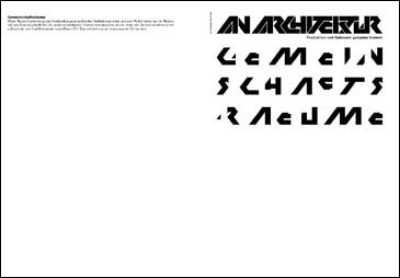
    An Architektur 10: Gemeinschaftsräume

  • An Architektur

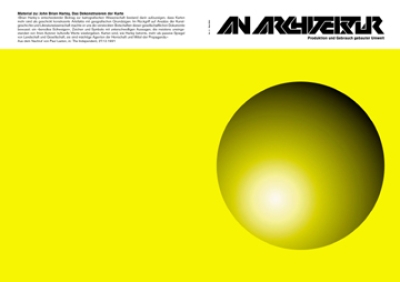
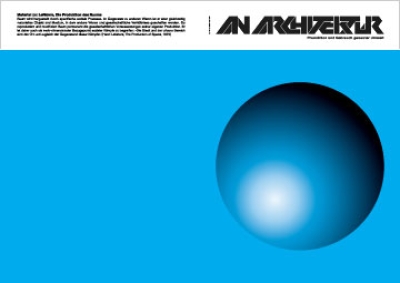
    An Architektur 04-09: Krieg und die Produktion von Raum

  • IDEA Magazine

    IDEA 296. Books <preposition> graphic design

  • IDEA Magazine

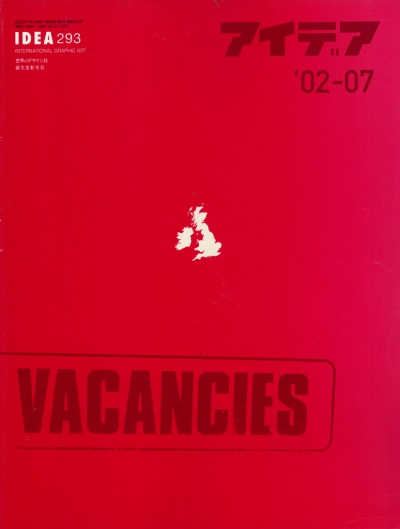
    IDEA 293. Stanley Donwood / Vacances. DD-DDD / Dimensions…

  • gerade nicht auf Lager
    An Architektur

    An Architektur 01-03

  • Pro qm

    Gutschein / Voucher

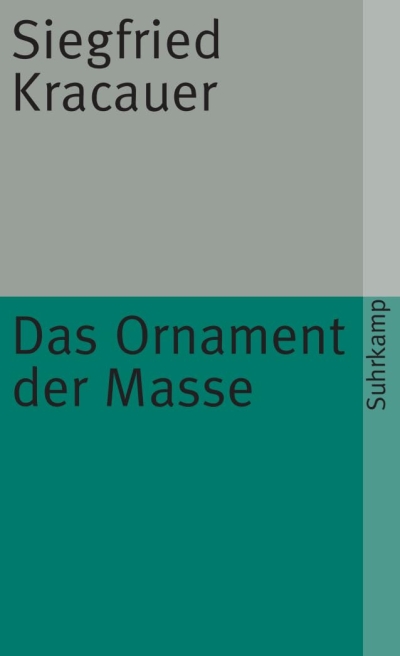
  • Siegfried Kracauer

    Das Ornament der Masse. Essays

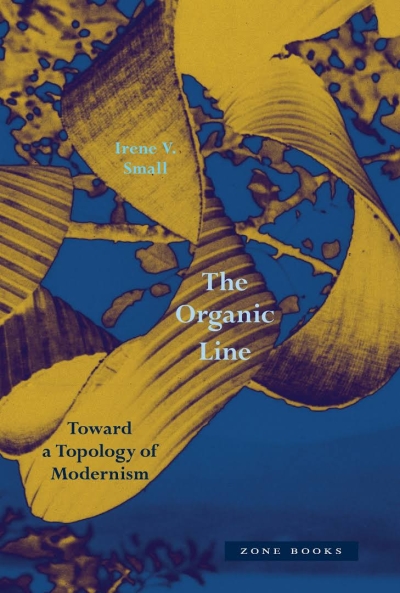
Irene V. Small. The Organic Line. Toward a Topology of Modernism

The Organic Line

Toward a Topology of Modernism

What would it mean to treat an interval of space as a line, thus drawing an empty void into a constellation of art and meaning-laden things? In this book, Irene Small elucidates the signal discovery of the Brazilian artist Lygia Clark in 1954: a fissure of space between material elements that Clark called “the organic line.” For much of the history of art, Clark’s discovery, much like the organic line, has escaped legibility. Once recognized, however, the line has seismic repercussions for rethinking foundational concepts such as mark, limit, surface, and edge. A spatial cavity that binds discrepant entities together, the organic line transforms planes into flexible topologies, borders into membranes, and interstices into points of connection. As a paradigm, the organic line has profound historiographic implications as well, inviting us to set aside traditional notions of influence and origin in favor of what Small terms weak links and plagiotropic relations. These fragile, oblique, and transversal ties have their own efficacy, and Small’s innovative readings of canonical modernist works such as Kazimir Malevich’s Black Square, John Cage’s 4’33”, and Le Corbusier’s machine-à-habiter, as well as contemporary works by such artists as Adam Pendleton, Ricardo Basbaum, and Mika Rottenberg, reveal the organic line’s remarkable potential as an analytic instrument. Mobilizing a rich repertoire of archival sources and moving across multiple chronologies, geographies, and disciplines, this book invites us to envision modernism not as a stable construct defined by centers and peripheries, inclusions and exclusions, but as a topological field of interactive, destabilizing tensions. More than a history of a little-known artistic device, The Organic Line: Toward a Topology of Modernism is a user’s guide and manifesto for reimagining modern and contemporary art for the present.


Irene V. Small
The Organic Line

Toward a Topology of Modernism

Zone Books, 2024, 978-1-890951-99-3
gerade nicht auf Lager