










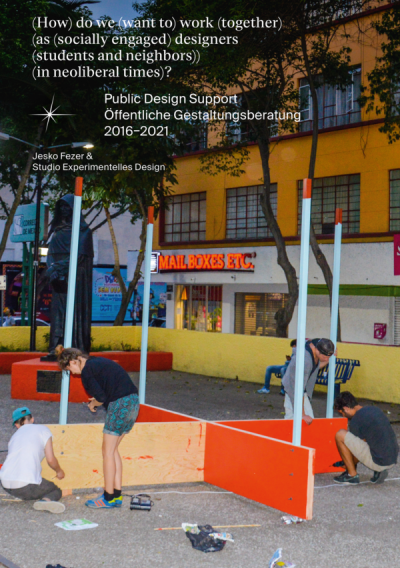
(How) do we (want to) work (together) (as (socially engaged) designers (students and neighbors)) (in neoliberal times)?
OUT OF PRINT
Public Design Support / Öffentliche Gestaltungsberatung 2016 - 2021
A critical discussion about work is urgently needed—in the field of design as much as anywhere else. Since 2011, Studio Experimentelles Design at the HFBK Hamburg has experimented with local design-assistance projects carried out within the framework of the St. Pauli Public Design Support initiative. The student-led program advocates a community based and cooperative approach, involving people who are usually only impacted by design or excluded from it. This partisan practice questions our understanding of what design can be, and who benefits or suffers from it. It also fundamentally questions how we work.
In the summer of 2020, Studio Experimentelles Design organized the three-week online research festival “(How) do we (want to) work (together) (as (socially engaged) designers (students and neighbors)) (in neoliberal times)?” Hosted by the Kunstgewerbemuseum Berlin’s Design Lab #6, the festival invited friends, experts, and activists to discuss self-organizing academia, artistic collectivism, care work, and creative self-exploitation. Talks, performances, and readings explored the dilemmas of project logic, the radical expansion of precarity, alternatives to the formal economy, immaterial labor in the context of aesthetic capitalism, the problem of the art strike, and new forms of subjective alienation.
Divided into two parts, this publication extends Studio Experimentelles Design’s socially committed approach through conversations, lectures, research, debates, and project documentation, drawing on the research festival as well as five years of work by Public Design Support. Both of these—an international debate on working conditions and a local design practice committed to its community—strive to critically examine design’s current practices. They ask questions of how designers work today, demanding a fundamental reorientation in the issues design addresses and the social actors it serves.