















Direkt zum Inhalt

Warenkorb

  • Johan Frederik Hartle

    Der geöffnete Raum. Zur Politik der ästhetischen Form

  • Jörg Dünne, Stephan Günzel (Hg.)

    Raumtheorie. Grundlagentexte aus Philosophie und…

  • An Architektur

    An Architektur 16-17

  • Vera Beyer, Jutta Voorhoeve, Anselm…

    Das Bild ist der König. Repräsentation nach Louis Marin

  • An Architektur

    An Architektur 15 / FFM 11: Europäische…

  • Orhan Esen, Stephan Lanz (Hg)

    Self Service City. Istanbul (metrozones 4)

  • An Architektur

    An Architektur 14: Camp for Oppositional Architecture

  • Stephan Lanz (Hg.)

    City of COOP. Ersatzökonomiern und städtische Bewegungen in…

  • An Architektur

    An Architektur 11-13: Theorie und Praxis der Kartografie

  • An Architektur

    An Architektur 10: Gemeinschaftsräume

  • Jochen Becker, Stephan Lanz (Hg.)

    Space//Troubles. Jenseits des Guten Regierens:…

  • Sarai media lab

    Sarai Reader 03: shaping technologies

  • An Architektur

    An Architektur 04-09: Krieg und die Produktion von Raum

  • IDEA Magazine

    IDEA 296. Books <preposition> graphic design

  • IDEA Magazine

    IDEA 293. Stanley Donwood / Vacances. DD-DDD / Dimensions…

  • gerade nicht auf Lager
    An Architektur

    An Architektur 01-03

  • Martina Löw

    Raumsoziologie

  • Pro qm

    Gutschein / Voucher

  • Brian O'Doherty

    In der weissen Zelle. Inside the White Cube

  • gerade nicht auf Lager
    Siegfried Kracauer

    Das Ornament der Masse. Essays

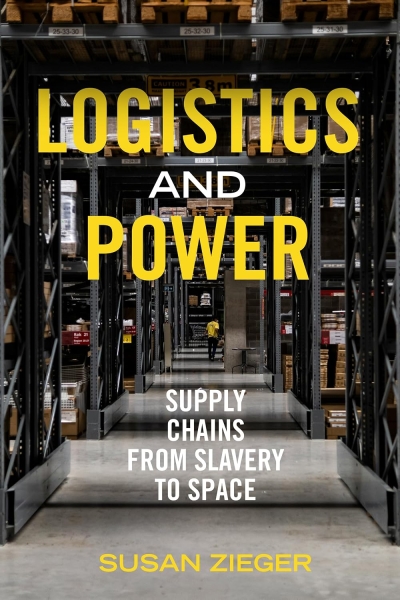
Logistics and Power. Supply Chains from Slavery to Space

Movement is the lifeblood of capital, even more so than growth. If goods, people, and information don't flow, then profits don't either. Ensuring that laborers, shipping containers, media, commercially valuable data, and much else are in the right place at the right time demands a subtle choreography. Enter logistics.

Susan Zieger argues that logistics is the foundation of power in our time. Blending detailed historical research with real-life stories that crystallize the human and ecological consequences of supply chains, Logistics and Power shows how the pursuit of efficient movement has come to organize economies while disordering societies and selves. Logistics emerges as the key to consumerism and the experience of work. It justifies corporate and police surveillance, illuminates patterns of migration and exploitation, and explains why the oceans are clotted with plastic. It is in the sphere of logistics that capitalist motives are most dramatically in tension with planetary needs.

A headfirst encounter with the obscure forces subordinating all goals below those of capital, Logistics and Power points the way to an alternative: a mindful and politically attentive kind of movement compatible with human thriving.


Susan Zieger
Logistics and Power. Supply Chains from Slavery to Space
University of California Press, 2025, 9780520402874
32,00 €