





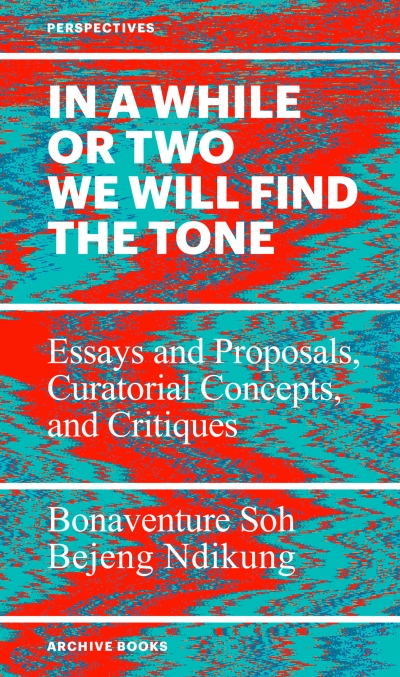
In a While or Two We Will Find the Tone
This collection of writings from Bonaventure Soh Bejeng Ndikung presents, for the first time in one volume, essays and proposals edited anew. Ndikung’s expanded curatorial practice delineates the space of exhibition making as a space of critical thinking and of experimentation. By proximity, these texts echo each other, resonate with each other, interfere with each other, and present perspectives on the political, poetic, and philosophical potentials of exhibition making, beyond the tight corset of the discipline itself.
From the introduction:
The exhibition space and exhibition making, physically and psychically speaking, to me, have always been spaces of and for deliberations and critique. Spaces of critical thinking and of experimentation. Spaces through which and in which certain socio-political phenomena, cultural or economical paradigms could be reevaluated and certain norms, in theory and practice, could be challenged, renegotiated and proposals made anew. In these spaces of negotiations, which I have previously written about (in the essay Defiance In/As Radical Love: Soliciting Friction Zones and Healing Spaces) in relation to Mary Louise Pratt’s notion of Contact Zones, one must appreciate the possibility of transcending the urge to preach harmony or synchrony to the choir, but also imagine such spaces as cognitive and physical spaces of dissonances and slippages, of disharmony and décallage, of marking time and stepping aside or backwards in an effort to gain another vantage point or field of view. In fact, maybe one of the tasks—surely not the only—of making exhibitions is devising tools and paths and strategies on how to gallop off the frame, if not to detonate it completely.