























Direkt zum Inhalt

Warenkorb

  • Ayoung Kim

    Synthetic Storyteller

  • gerade nicht auf Lager
    Magda Danysz

    Street Art. An Anthology

  • Karen van den Berg

    Große Kunst. Hyperwachstum in der Studiopraxis

  • gerade nicht auf Lager
    Chris Hables Gray

    Virus is a Language. AI, QAnon, COVID-19 and the New…

  • Jan Schwochow

    InGraphics 2026 Edition

  • David Reinfurt

    A *Co-* Program for Graphic Design

  • gerade nicht auf Lager
    Patrik Hübner

    The Generative Mind. A New Approach to Creative Thinking

  • gerade nicht auf Lager
    Charlie Singer-Fischer

    Between the Lines. KI - schöne neue Zukunft?

  • Olivia Laing

    The Silver Book

  • Jacques Lacan

    Einige Überlegungen zum Ich. Some Reflections on the Ego

  • Peter Swinnen, Anne Judong (eds.)

    Willy Van Der Meeren. Mass

  • Shirley Surya, Li Hua (Eds.) Canadian…

    How Modern. Biographies of Architecture in China 1949–1979

  • Marta Ceccarelli

    Postscriptum 53. Internet's Dark Forests: Subcultural…

  • Sophie Publig

    The Postscriptum 54: Swiping Right on God

  • Dave Randall

    Sound System. The Political Power of Music

  • Mikkel Bolt Rasmussen

    The Refusalist International. A Theory of the New Protest…

  • Esra Akcan

    Architecture and the Right to Heal. Resettler Nationalism…

  • Kerstin Decker (Autorin), Ute Müller-…

    Das Graue Kloster von Berlin. Biografie eines…

  • Okwui Enwezor, Terry Smith (Ed.)

    Okwui Enwezor. Selected Writings. Volume 2. Curating the…

  • Okwui Enwezor, Terry Smith (Ed.)

    Okwui Enwezor. Selected Writings. Volume 1. Toward a New…

  • Benedikt Boucsein, Elettra Carnelli,…

    Die Macht der Bedingungen. Architektur zwischen…

  • Jeppe Ugelvig (Ed.)

    Viscose Journal 01. Style (Reprint)

  • Giulia Boller, Matthias Beckh, Rainer…

    Heinz Isler. Built Experiments – Entrepreneurial Networks

  • Carolyn F. Strauss (ed.)

    Slow Technology Reader

  • gerade nicht auf Lager
    Geert Lovink

    Platform Brutality. Closing Down Internet Toxicity

  • Javier Mozas, Aurora Fernández Per

    Housing Loops. Opulence, Precarity, Dignity, Prosperity and…

  • gerade nicht auf Lager
    Marijke Goeting & Maaike van Neck (…

    Algorithmic Imaginations. Critical Reflections on AI in Art…

  • Riccarda Cappeller

    Cooperative Architecture. Urban Transformation as Process,…

  • Michelle Teran, Marc Herbst, Vivian Sky…

    Promiscuous Infrastructures. Practising Care

  • Camille Belmin (Ed)

    Ecoslay – An Anthology

  • Meltdown Your Books

    Empires Over Skin. How we Fashioned our World

  • gerade nicht auf Lager
    Claus Krieger

    111 Architekturbaukästen

  • Basile Baudez, Victoria Bergbauer (Hg.)

    Carceral Architecture

  • Cornelia Wild (Hrsg.), Pier Paolo…

    Dialoge mit Pasolini

  • Charlotte Laubard

    Manifestes 8. Changing Art from the Outside in

  • Philippe Rahm

    Manifestes 6. The Anthropocene Style

  • Iracema Dulley, Marlon Miguel (eds.)

    Stella do Patrocínio. Falatório/Chatter

  • Christoph Ramisch (ed.)

    Daidalos 24-25

  • Mick Wilson

    On Discourse and the Curatorial

  • Bjørn Hegardt (Ed.)

    FUKT #23 – The Sound Issue

  • pinamagazine.com

    Pina Issue 2

  • Marina Vinnik

    Objekt-Orientiertes Bauhaus. Object-Oriented Bauhaus

  • Brandon LaBelle (Ed.)

    The Listening Biennial Reader - Vol 2: Infralistening

  • Erik Göngrich, Aurelia Markwalder,…

    Alles Allen

  • Eva Bentcheva, Annie Jael Kwan, Ming…

    Thinking Collectives / Collective Thinking

  • Christoph F. E. Holzhey, Marietta…

    Breaking and Making Models

  • Beatriz Colomina, Mark Wigley

    We the Bacteria. Notes Toward Biotic Architecture

  • Thomas Aguilera, Francesca Artioli,…

    Housing Under Platform Capitalism. The Contentious…

  • Christoph Brunner, Kathrin Busch, Knut…

    Permeationen. Durchdringungen von künstlerischer Forschung…

  • gerade nicht auf Lager
    Maxime Le Calvé

    Golden Pudel-Ethnographie. Atmosphäre, Netzwerke und…

  • gerade nicht auf Lager
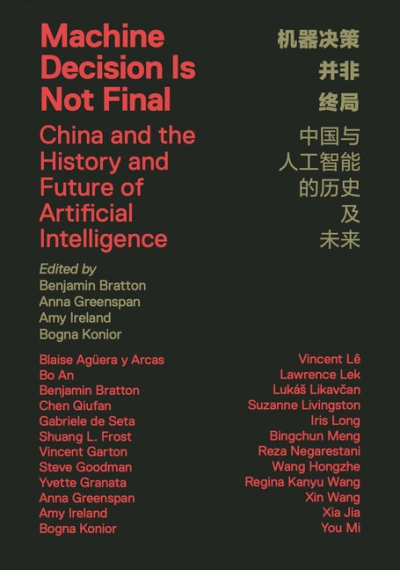
    Bogna Konior

    The Dark Forest Theory of the Internet

  • Martin Lorenz

    Flexible Visual Systems. The FVS Atlas

  • gerade nicht auf Lager
    Alexander Alberro

    Interstices. Negotiations at Contemporary Art’s Boundaries

  • Neil Brenner, Swarnabh Ghosh, Nikos…

    Environments of Planetary Urbanization

  • gerade nicht auf Lager
    Edited by Beatriz Colomina with Nick…

    Sick Architecture

  • gerade nicht auf Lager
    Simon Unwin

    What Student Architects Should Do

  • Amy Ireland, Maya B. Kronic

    Cuter Akzelerationismus

  • Elbe Trakal (Hg.)

    Zwischen Tätigkeiten Berichte

  • Stiftung Bauhaus Dessau (Hg.)

    On Behalf of the Environment. Pedagogies of Unrest. Bauhaus…

  • Aaron Betsky

    Assemble. Building Collective

  • Catherine Bedard, Lea-Catherine Szacka

    Crossed Histories: Gae Aulenti, Ada Louise Huxtable,…

  • Paul Guillibert

    Anthropocene Communism

  • Alexander Kluge

    Schattenrisse der Macht. Ein Zwölf-Caesaren-Kommentar

  • Ralf Hoffrogge

    Das laute Berlin. Deutsche Wohnen & Co enteignen und…

  • gerade nicht auf Lager
    Cara Hähl-Pfeifer, Damjan Kokalevski,…

    City in the Cloud – Data on the Ground. Architektur und…

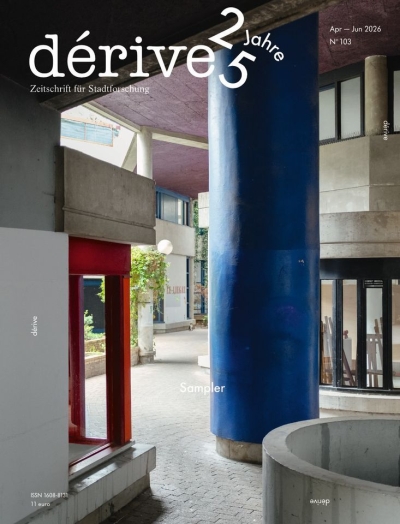
  • dérive

    dérive N° 101, Rhythmen, Zyklen, Zeitregime (Okt - Dez 2025)

  • Bernard Stiegler. Translated by Daniel…

    Bernard Stiegler, The Immense Regression: What Is Called…

  • Spike

    Spike Art Magazine Issue 85 Nostalgia

  • gerade nicht auf Lager
    Hito Steyerl

    Medium Hot. Bilder in Zeiten der Hitze

  • Ludovic Balland, Francesca Mautone,…

    Unfinished Atlas. 19 Projects by Manuel Herz Architects

  • Emanuel Christ, Victoria Easton, Giulio…

    Review No IV. Typology - Tashkent, Genoa, Tbilisi,…

  • Jeppe Ugelvig (Ed.), Bill Kouligas,…

    Viscose Journal 08. Sound

  • András Szántó

    The Future of the Art World. 38 Dialogues

  • Lucius Burckhardt, Martin Schmitz (Hg)

    Lucius Burckhardt und der Werkbund

  • Olaf Bahner, Laura Holzberg, Bund…

    Baustelle Transformation. Zehn Strategien für Stadt und Land

  • Sandro Mezzadra, Brett Neilson

    Der Rest und der Westen. Kapital und Macht in einer…

  • Anja Lutz, Soraya Guimarães Hoepfner (…

    On the Edges of Graphic Design from A—Z—∞. A Space for…

  • Elke Couchez & Hamish Lonergan

    This Is Not a Summer School. The International Laboratory…

  • Matter Of (eds.)

    New New Typography. Adventures in Transborder Typography

  • gerade nicht auf Lager
    Wilfried Kuehn, Dubravka Sekulić (eds.)

    Curatorial Design. A Place Between

  • Nigel Cottier (ed.)

    Alphabetical Playground

  • Quang Vinh Nguyen, Émilie Laystary (…

    Vietnamese Objects. The material culture of resilience in…

  • Helen Hester, Will Stronge

    Post-work. What It Is, Why It Matters and How We Get There

  • gerade nicht auf Lager
    Terrassen

    Yvonne Rainer. Privilege - Yvonne Rainer Filmography

  • Rebecco Ann Tess

    Alpha++ Models / rendered lives in global cities

  • Eva Stricker, Dirk Bayer, Jürgen Graf,…

    Wege zur Bauwende. Klima- und ressourcenschonend…

  • gerade nicht auf Lager
    Carlo Bramanti

    Conspiratorial Design. Information design for the bigger…

  • Mona Schieren, Oscar Svanelid

    Lygia Clarks künstlerische Methode der Strukturierung des…

  • Andreas Broeckmann

    The Making of Les Immatériaux

  • Stiftung Bauhaus Dessau, Regina Bittner…

    Not a Penguin Pool Echoes of More-Than-Human Entanglements…

  • Sandra Hofmeister (Hg)

    Architektur und Klimawandel (Vol. 2). 20 Interviews zur…

  • Blaise Agüera y Arcas

    What Is Life? Evolution as Computation

  • gerade nicht auf Lager
    Kristoffer Tjalve, Elliott Cost (Eds.)

    Internet Phone Book. A directory for exploring the vast…

  • Thomas Wüthrich, Yves Raschle

    Nachhaltige Designprozesse. Leitfaden für die…

  • Elizabeth A. Wilson (Autorin),…

    Maschinenaffekte

  • Félix Guattari (Autor), Volker Bernhard…

    Die subjektive Stadt. Schriften zu Architektur und…

  • Arch+

    ARCH+ 261 Stadtumbau – Schulen der Transformation (…

  • Jonas Deuter

    Karl Gerstner: Der Traum vom Absoluten. Struktur und…

Idea 412. Tomoyuki Arima: Design Evolving from Relationships

Direction by Toshinobu Nagata & Idea 
Design by LABORATORIES(Kensaku Kato, Sae Kamata, Sakura Koizumi)

The state of technology has persistently played a large part in influencing design and designers. Applications once the domain of specialists with technical training are now improved, offering more advanced functionality and also more intuitive and accessible than ever. Now anyone can produce any kind of graphics, regardless of their educational background.

On the other hand, unease surrounding the rapid advance of automated technology is spreading, as evidenced by the fierce debates over the merits of AI technology. If we all use the same applications with the same technical support, will everything end up looking the same? Rather than adjusting technology to suit humans, it is as though humans are being adjusted to suit technology. We may be headed towards design (or designer) dystopia like this.

Tomoyuki Arima (of Arima Design Institute at the Nippon Design Center) has kept real-time pace with digital innovation since 2000. He has no specialized design education from any art university. He absorbed games and the internet through computers, discovered manga and anime culture on the web, learned graphic design through music, met people through dojin design, and continuously expanded his professional domain through interaction. Web, books, packaging, branding, animation, games, exhibitions—he has constantly explored for the connections between technology and people, and has made liberal use of applications as though they were readily-available tools.

This feature is a summary of Tomoyuki Arima’s career. Arima has consistently created designs from the relationships between technology and people. Rather than defining his professional scope by any given occupational ability, he has established the domain of his work through each project depending on the demand (or lack thereof); all driven by his own motivation. It’s not about where design ends: it’s about what design includes. He exerts himself not as a designer, but as someone capable of design. This approach inspires project associates, blurs the boundaries between client and designer, supersedes style, and defines what is Tomoyuki Arima Design.

Reviewing Arima’s work has prompted us to reexamine the relationship between technology and design in the modern era. It has also shifted our gaze to the ‘human’ element that must exist for design to remain human endeavor: an element that should serve as a guiding principle for designers headed into the 2030s. We hope this feature will provide encouragement to all aspiring designers.


IDEA Magazine
Idea 412. Tomoyuki Arima: Design Evolving from Relationships
Seibundo Shinkosha, 2025, IDEA 412 2025.12
36,00 €