Direkt zum Inhalt

Warenkorb

  • Jörg Dünne, Stephan Günzel (Hg.)

    Raumtheorie. Grundlagentexte aus Philosophie und…

  • An Architektur

    An Architektur 16-17

  • Vera Beyer, Jutta Voorhoeve, Anselm…

    Das Bild ist der König. Repräsentation nach Louis Marin

  • An Architektur

    An Architektur 15 / FFM 11: Europäische…

  • Orhan Esen, Stephan Lanz (Hg)

    Self Service City. Istanbul (metrozones 4)

  • An Architektur

    An Architektur 14: Camp for Oppositional Architecture

  • Stephan Lanz (Hg.)

    City of COOP. Ersatzökonomiern und städtische Bewegungen in…

  • An Architektur

    An Architektur 11-13: Theorie und Praxis der Kartografie

  • An Architektur

    An Architektur 10: Gemeinschaftsräume

  • Jochen Becker, Stephan Lanz (Hg.)

    Space//Troubles. Jenseits des Guten Regierens:…

  • Sarai media lab

    Sarai Reader 03: shaping technologies

  • An Architektur

    An Architektur 04-09: Krieg und die Produktion von Raum

  • IDEA Magazine

    IDEA 296. Books <preposition> graphic design

  • IDEA Magazine

    IDEA 293. Stanley Donwood / Vacances. DD-DDD / Dimensions…

  • gerade nicht auf Lager
    An Architektur

    An Architektur 01-03

  • Martina Löw

    Raumsoziologie

  • Pro qm

    Gutschein / Voucher

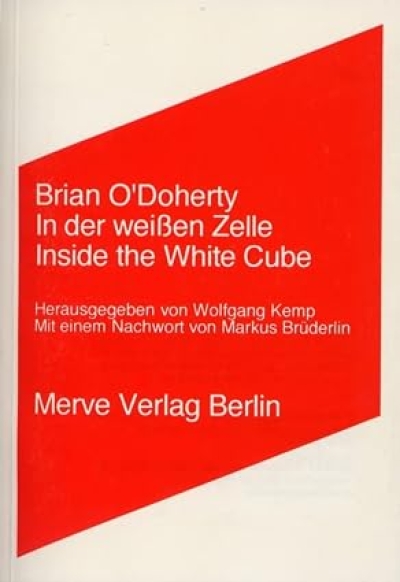
  • Brian O'Doherty

    In der weissen Zelle. Inside the White Cube

  • gerade nicht auf Lager
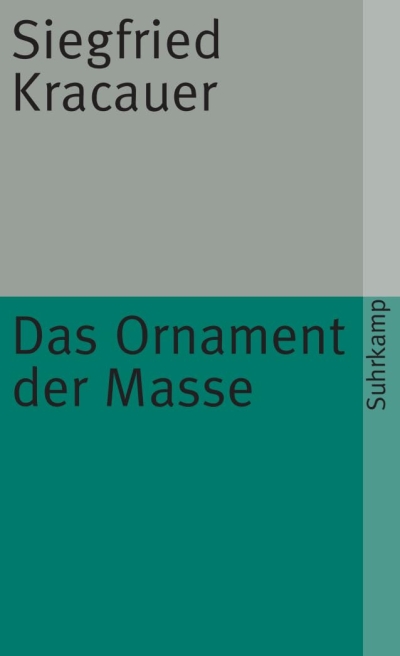
    Siegfried Kracauer

    Das Ornament der Masse. Essays

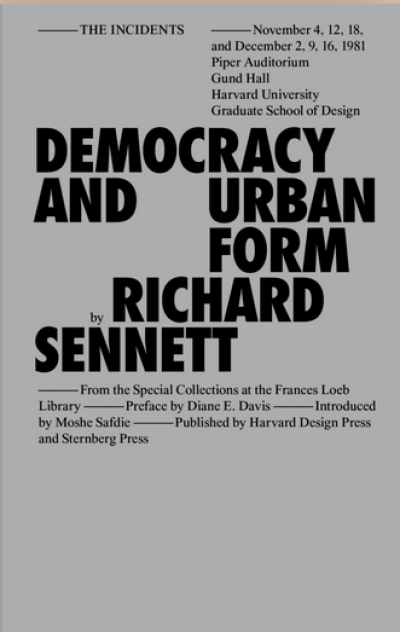
cover Democracy and Urban Form

Democracy and Urban Form

“Never have the potential political consequences of architecture been greater, and never has the political sensibility of architecture been less.”

This was the state of the discipline that social theorist and urban thinker Richard Sennett declared when he addressed an audience at the Harvard University Graduate School of Design in 1981. Over a series of six lectures, Sennett presented social discourse as the foundation of democracy, and posited that our cities are uniquely positioned to either empower or constrict this discourse—and that the difference could lie in architecture and urban design.

Now, over forty years later, as political polarization persists and its consequences arise in both new and familiar ways, Democracy and Urban Form revisits questions that remain relevant: If discourse is the foundation of democracy, how can the design of our cities empower and enable it?


Richard Sennett
Democracy and Urban Form
Sternberg, 2024, 978-1-915609-47-2
gerade nicht auf Lager