




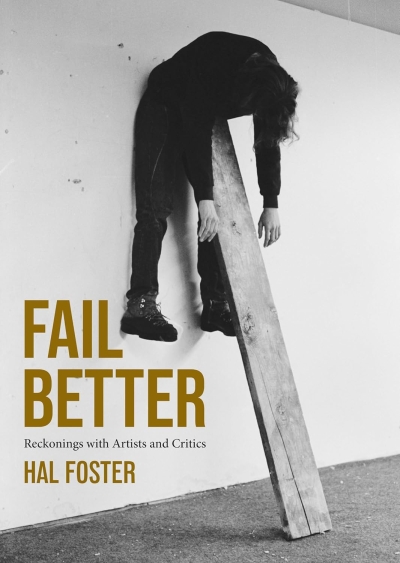
Fail Better. Reckonings with Artists and Critics
“Serious art anticipates the future as much as it reflects the present,” Hal Foster remarked in a 2015 interview. “By the same token serious art history is driven by the present as much as it is informed by the past.” In Fail Better, Foster, an art critic and historian whose influential work spans disciplines and decades, brings this peripatetic perspective to contemporary art, art criticism, art history, and his own work over the past 50 years.
In these 40 texts, Foster reviews artists from Richard Hamilton and Jasper Johns to Gerhard Richter and Ed Ruscha; considers contemporaries from Louise Lawler and Cindy Sherman to Jeremy Deller and Adam Pendleton; and traces the development of criticism since the early 1960s, with essays on such influential figures as Susan Sontag and Rosalind Krauss and institutions like Artforum magazine and the Whitney Museum Independent Study Program.
Taking his title from Beckett—“try again, fail again, fail better”—Foster notes that, etymologically, an essay is always an attempt, more or less failed. Critics fail artworks, because there can never be a definitive reading; art fails its historical moment, because it cannot resolve the contradictions that prompt it. But in these failures Foster finds historical consciousness, and with it the promise of future work, future illumination. In his “reckonings” he turns his own long history of criticism to account, and succeeds in conveying shifting concepts of art and criticism, the work of key artists and critics, and the relationships between criticism, theory, history, and politics over the last six decades.