


















Technocreep and the Politics of Things Not Seen
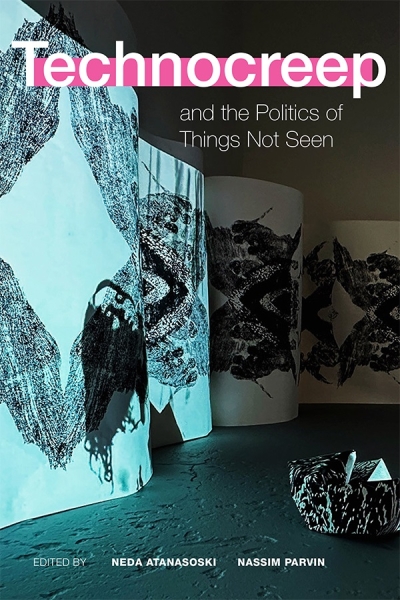
New and emerging technologies, especially ones that infiltrate intimate spaces, relations, homes, and bodies, are often referred to as creepy in media and political discourses. In Technocreep and the Politics of Things Not Seen, Neda Atanasoski and Nassim Parvin introduce a feminist theory of creep that they substantiate through critical engagement with smart homes, smart dust, smart desires, and smart forests toward dreams of feminist futures. Contributing authors further illuminate what is otherwise obscured, assumed, or dismissed in characterizations of technology as creepy or creeping. Considering diverse technologies such as border surveillance and China’s credit system to sexcams and home assistants, the volume’s essays and artworks demonstrate that the potentials and pitfalls of artificial intelligence and digital and robotic technologies cannot be assessed through binaries of seeing/being seen, privacy/surveillance, or harmful/useful. Together, their multifaceted and multimodal approach transcends such binaries, accounting for technological relations that exceed sight to include touch, presence, trust, and diverse modes of collectivity. As such, this volume develops creep as a feminist analytic and creative mode on par with technology’s complex entanglement with intimate, local, and global politics.
Contributors. Neda Atanasoski, Katherine Bennett, Iván Chaar López, Sushmita Chatterjee, Hayri Dortdivanlioglu, Sanaz Haghani, Jacob Hagelberg, Jennifer Hamilton, Antonia Hernández, Marjan Khatibi, Tamara Kneese, Erin McElroy, Vernelle A. A. Noel, Jessica Olivares, Nassim Parvin, Beth Semel, Renee Shelby, Tanja Wiehn