


















Direkt zum Inhalt

Warenkorb

  • gerade nicht auf Lager
    Peter Weibel (Hg.)

    Sound Art: Sound as a Medium of Art

  • gerade nicht auf Lager
    Walter Scheiffele

    Ostmoderne-Westmoderne

  • gerade nicht auf Lager
    Samuel Greengard

    Virtual Reality

  • Ion Grigorescu

    From static oblivion

  • gerade nicht auf Lager
    Guy Standing

    Plunder of the Commons: A Manifesto for Sharing Public…

  • gerade nicht auf Lager
    Sofia Bempeza

    Geschichte(n) des Kunststreiks

  • gerade nicht auf Lager
    Vilém Flusser

    Vom Stand der Dinge. Eine kleine Philosophie des Design

  • gerade nicht auf Lager
    Jane Hall

    Breaking Ground: Architecture by Women

  • gerade nicht auf Lager
    Jason Bahbak Mohaghegh

    Omnicide: Mania, Fatality, and the Future-in-Delirium

  • Chantal Akerman

    My Mother Laughs

  • Stiftung Buchkunst

    Die Schönsten Deutschen Bücher 2019: The Best German Book…

  • Franco "Bifo" Berardi

    Die Seele bei der Arbeit: Von der Entfremdung zur Autonomie

  • gerade nicht auf Lager
    Judith Butler

    Rücksichtslose Kritik. Körper, Rede, Aufstand

  • Alexandra Hopf, Regine Steenbock

    Vogue. M29 Special.09/2019 September

  • J. Dowling, C. Leterme

    From Latin America

  • gerade nicht auf Lager
    Matthias Schmelzer, Andrea Vetter

    Degrowth / Postwachstum zur Einführung

  • M. Rothenberger, T. Weber (Hg)

    Nico – Wie kann die Luft so schwer sein an einem Tag an dem…

  • gerade nicht auf Lager
    Marcel Hénaff

    Die Stadt im Werden

  • gerade nicht auf Lager
    Francesco Garutti

    Our Happy Life. Architecture and Well-Being in the Age of…

  • gerade nicht auf Lager
    Kenya Hara

    Designing Japan. A Future Built on Aesthetics

  • gerade nicht auf Lager
    Janwillem Schrofer (Ed.)

    Plan and Play, Play and Plan: Defining Your Art Practice

  • gerade nicht auf Lager
    Giorgio Agamben

    Creation and Anarchy: The Work of Art and the Religion of…

  • gerade nicht auf Lager
    Danae Io, Callum Copley (Ed.)

    Schemas of Uncertainty

  • gerade nicht auf Lager
    Lucy Cotter

    Reclaiming Artistic Research

  • gerade nicht auf Lager
    Sabine Hansmann, Finn Geipel (Hg.)

    Raummaschine: Exploring the Manifold Spaces

  • Peter Donhauser

    Musikmaschinen: Die Geschichte der Elektromusik

  • gerade nicht auf Lager
    Amanda Boetzkes

    Plastic Capitalism. Contemporary Art and the Drive to Waste

  • gerade nicht auf Lager
    Stefanie Graefe

    Resilienz im Krisenkapitalismus: Wider das Lob der…

  • Daniel Johnston

    Where are the ducks when you need them?

  • gerade nicht auf Lager
    Daniel Birnbaum, Sven-Olov Wallenstein

    Spacing Philosophy: Lyotard and the Idea of the Exhibition

  • Roland Meyer

    Operative Porträts. Eine Bildgeschichte der…

  • gerade nicht auf Lager
    A. Juppien, R. Zemp

    Vokabular des Zwischenraums: Gestaltungsmöglichkeiten von…

  • gerade nicht auf Lager
    Paul O'Neill, Simon Sheikh, Lucy…

    Curating after the Global: Roadmaps for the Present

  • gerade nicht auf Lager
    Maya Vinitsky (Ed.)

    Solar Guerrilla: Constructive Responses to Climate Change

  • gerade nicht auf Lager
    Annette Jael Lehmann

    Tacit Knowledge. Feminism / Post Studio (Post Studio /…

  • gerade nicht auf Lager
    G. Cachin (Hg.)

    Bobst Graphic. 1972 - 1981

  • gerade nicht auf Lager
    H. Bodenschatz, D. Brantz

    Grünfrage und Stadtentwicklung. 100 Jahre Groß-Berlin

  • gerade nicht auf Lager
    Christoph Cox

    Sonic Flux: Sound, Art, and Metaphysics

  • gerade nicht auf Lager
    Rosi Braidotti, Simone Bignall (eds.)

    Posthuman Ecologies. Complexity and Process after Deleuze

  • gerade nicht auf Lager
    T. Garcia, V. Normand (Hg)

    Theater, Garden, Bestiary: A Materialist History of…

  • gerade nicht auf Lager
    James Bridle

    New Dark Age: Der Sieg der Technologie und das Ende der…

  • gerade nicht auf Lager
    Sabine Breitwieser (Ed.)

    E.A.T. - Experiments in Arts and Technology

  • Richard Buckminster Fuller

    R. Buckminster Fuller. Nine Chains to the Moon. An…

  • Ulrike Bernard

    Wuan Wandeln

  • gerade nicht auf Lager
    C. Leonard, L. Khonsary (Hg)

    The Halifax Conference. Oct. 5&6 1970

  • gerade nicht auf Lager
    Birgit Rieger, Claudia Wahjudi

    Berlin Interviews. 16 Künstlerinnen und Künstler über eine…

  • Paolo Cirio

    Evidentiary Realism. Investigative, Forensic, Documentary…

  • Robert Kronenburg

    This Must Be The Place: An Architectural History of Popular…

  • gerade nicht auf Lager
    Oliver Marchart

    Conflictual Aesthetics: Artistic Activism and the Public…

  • Jürgen Hasse, Sara F. Levin

    Betäubte Orte: Erkundungen im Verdeckten

  • gerade nicht auf Lager
    Alexandra Klei

    Wie das Bauhaus nach Tel Aviv kam: Re-Konstruktion einer…

  • Sarah Banet-Weiser

    Empowered. Popular Feminism and Popular Misogyny

  • Stephen Prina

    As He Remembered It

  • Christoforos Savva

    Untimely, Again

  • gerade nicht auf Lager
    Barbagallo, Beuret, Harvie (Hg.)

    Commoning with George Caffentzis and Silvia Federici

  • A Prior #20

    The Research Issue

  • gerade nicht auf Lager
    Bernard Stiegler

    The Age of Disruption: Technology and Madness in…

  • gerade nicht auf Lager
    Edgar Cabanas, Eva Illouz

    Manufacturing Happy Citizens: How the Science and Industry…

  • gerade nicht auf Lager
    C. Profanter, H. Andersen, J. Eckhardt…

    The Middle Matter. Sound as Interstice

  • I. Galuzin, G. Severianova (Eds.)

    The Withdrawal of the Red Army

  • gerade nicht auf Lager
    IDEA #381

    Transboundary Design. Perspective of Yoshihisa Tanaka

  • gerade nicht auf Lager
    Andres Lepik, Daniel Talesnik (Hg)

    Access for All. São Paulo's Architectural…

  • gerade nicht auf Lager
    Isabelle Graw, Christoph Menke (eds.)

    The Value of Critique: Exploring the Interrelations of…

  • gerade nicht auf Lager
    Bernhard Denkinger

    Die vergessenen Alternativen. Strukturalismus und…

  • P. Bogner, G. Zillner

    Frederick Kiesler: Face to Face with the Avant-Garde:…

  • gerade nicht auf Lager
    Jonathan Hill

    The Architecture of Ruins: Designs on the Past, Present and…

  • gerade nicht auf Lager
    L. Giusti, N. Ricciardi (Eds.)

    Museums at the Post-Digital Turn

  • IDEA Magazine

    IDEA 386. Ministry of Graphic Design Fikra Graphic Design…

  • gerade nicht auf Lager
    Gregor H. Lersch, Léontine Meijer-van…

    Mischa Kuball. res.o.nant

  • gerade nicht auf Lager
    Marco Revelli

    The New Populism: Democracy Stares into the Abyss

  • gerade nicht auf Lager
    Jacques Ranciere

    Aisthesis: Scenes from the Aesthetic Regime of Art

  • gerade nicht auf Lager
    Gean Moreno

    In the Mind but Not from There. Real Abstraction and…

  • gerade nicht auf Lager
    Saskia de Wit

    Hidden Landscapes. The metropolitan garden as a multi-…

  • Tchoban Foundation

    Deutsche Filmarchitektur 1918–1933 – German Film…

  • gerade nicht auf Lager
    Natascha Süder Happelmann

    Ankersentrum (surviving in the ruinous ruin)

  • HeK (House of Elecronics Basel)

    Entangled Realities: Living with Artificial Intelligence /…

  • gerade nicht auf Lager
    Rosi Braidotti

    Posthuman Knowledge

  • gerade nicht auf Lager
    Jochen Volz, Gabi Ngcobo (Eds.)

    We Are Many. Art, the Political and Multiple Truths

  • gerade nicht auf Lager
    Fitz, Krasny, Architekturzentrum Wien (…

    Critical Care. Architecture and Urbanism for a Broken Planet

  • gerade nicht auf Lager
    Anne Kockelkorn, Nina Zschocke (Hg)

    Productive Universals. Specific Situations: Clinical…

  • Elke Neumann

    Palast der Republik. Utopie, Inspiration, Politikum

  • Troy Schaum (Ed.)

    Totalization: Speculative Practice in Architectural…

  • gerade nicht auf Lager
    F. Serapiao, G. Wisnik

    Infinite Span. 90 Years of Brazilian Architecture

  • gerade nicht auf Lager
    Heike Munder (Ed.)

    Producing Futures: A Book on Post-Cyber-Feminisms

  • gerade nicht auf Lager
    L. Giusti, N. Ricciardi (Eds.)

    Museums at the Post-Digital Turn

  • Victor Papanek

    Design for the Real World

  • gerade nicht auf Lager
    Andreas, Jung, Schmal (Hg.)

    Wohnen für Alle: Bautenkatalog

  • gerade nicht auf Lager
    Elizabeth Resnick

    The Social Design Reader

  • gerade nicht auf Lager
    Anca Benera, Arnold Estefan

    DEBRISPHERE - Landscape as an Extension of the Military…

  • gerade nicht auf Lager
    Fiona McGovern, Megan Francis Sullivan…

    Jill Johnston. The Disintegration of a Critic

  • gerade nicht auf Lager
    Camiel van Winkel

    Archive Species: Bodies, Habits, Practices

  • gerade nicht auf Lager
    Ted Hyunhak Yoon

    Decoding Dictatorial Statues

  • Sophie Cure, Aurelien Farina

    Graphic Design Play Book: An Exploration of Visual Thinking

  • gerade nicht auf Lager
    Danielle Child

    Working Aesthetics: Labour, Art and Capitalism

  • gerade nicht auf Lager
    Katya Garcia-Anton

    Sovereign Words. Indigenous Art, Curation and Criticism

  • gerade nicht auf Lager
    Lorraine Daston

    Against Nature

  • gerade nicht auf Lager
    Brigitta Gerber, Ulrich Kriese (Hg)

    Boden behalten - Stadt gestalten

  • gerade nicht auf Lager
    Dominik Landwehr (Hg.)

    Virtual Reality: Edition Digital Culture 6

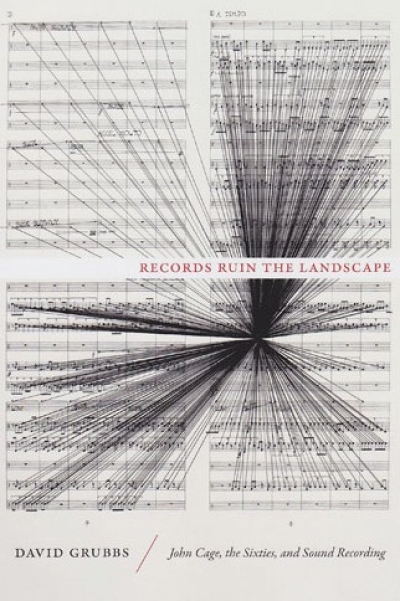
Records Ruin the Landscape. John Cage, the Sixties, and Sound Recording

John Cage's disdain for records was legendary. He repeatedly spoke of the ways in which recorded music was antithetical to his work. In Records Ruin the Landscape, David Grubbs argues that, following Cage, new genres in experimental and avant-garde music in the 1960s were particularly ill-suited to be represented in the form of a recording. These activities include indeterminate music, long-duration minimalism, text scores, happenings, live electronic music, free jazz, and free improvisation. How could these proudly evanescent performance practices have been adequately represented on an LP? In their day, few of these works circulated in recorded form. By contrast, contemporary listeners can encounter this music not only through a flood of LP and CD releases of archival recordings, but also in even greater volume through Internet file-sharing and online resources. Present-day listeners are coming to know that era's experimental music through the recorded artifacts of composers and musicians who largely disavowed recordings. In Records Ruin the Landscape, Grubbs surveys a musical landscape marked by altered listening practices.
"Records Ruin the Landscape is a pleasure to read, full of wonderful anecdotes and historical material. David Grubbs approaches John Cage and his legacy from a new and refreshing angle, by examining the vexed relationship of experimental and improvised music to recording and phonography. The questions that he poses - about the ontology and potentiality of recording in relation to live performance, improvisation, chance, and indeterminacy - are important, and he answers them in smart and provocative ways." - Christoph Cox, coeditor of Audio Culture: Readings in Modern Music "The premise of [Grubbs's] understandably authoritative first book is that experimental music's flowering in the 1960s... was incompatible with the limitations of orthodox recording formats...With an engaging frankness... Grubbs contrasts this tendency with his own fan-by appetite for records and the documentary efficacy of the contemporary digital realm, concluding positively that the latter potentially offers unmediated, universal access to the panoply of esoteric music - something unthinkable in the 1960s." - David Sheppard, Mojo "Ambivalence is a central theme of David Grubbs' records Ruin the Landscape. Specifically his interest is in experimental music of the 1960s [...] This is an engaging book." - Times Higher Education "The book is a swift and delightful document of ambivalence. [...] One needn't be a committed fan of Cage's, or Bailey's, to enjoy the challenge of thinking about how recordings alter, enhance, or distort the experience of live performance." - New Yorker "For compositions whose whole raison d'etre is to generate a drastically different realization with every performance (most often by providing "scores" that give the performers tremendous latitude), no recording of any one performance could be said to "be" the piece. David Grubbs's exhaustively researched Records Ruin the Landscape explores this dilemma specifically as it affected the generation of avant-garde composers who hit their stride in the sixties, John Cage being the most prominent and outspoken among them." - Los Angeles Review of Books "The risk writers run, of course, with the big questions approach, is universalising their personal narrative in order to present the big answer. Grubbs is too skilled and self-aware to run into this problem. His breadth of research in musicology and aesthetic theory is balanced in this short and engaging book with candid writing about his own experiences of recordings of experimental music. [...] It is testament to Grubbs's sensitivity as a writer that sympathetic picture merges of these musicians, who seem often to be railing against hierarchies they can't quite help being part of." - The Wire "[A] rather magnificent survey of the ideas of the experimental music world over the last 40 or 50 years that doubles as an offhanded paean to record collecting. Grubbs not only knows about all of this stuff, he cares deeply about it, and there aren't that many punk guitarists whose range of interests is quite this wide [...] In this way, it seems that Grubbs is sort of a one of a kind." - Salon
David Grubbs is Associate Professor in the Conservatory of Music at Brooklyn College, City University of New York, where he also teaches in the M.F.A. programs in Performance and Interactive Media Arts and Creative Writing. As a musician, he has released twelve solo albums and appeared on more than 150 commercially released recordings. Grubbs was a founding member of the groups Gastr del Sol, Bastro, and Squirrel Bait, and has appeared on recordings by the Red Krayola, Tony Conrad, Pauline Oliveros, Will Oldham, and Matmos, among other artists. He is known for cross-disciplinary collaborations with the writers Susan Howe and Rick Moody and the visual artists Anthony McCall, Angela Bulloch, and Stephen Prina. A grant recipient in music/sound from the Foundation for Contemporary Arts, Grubbs has written for "The Wire," "Bookforum," and the "Suddeutsche Zeitung."


David Grubbs
Records Ruin the Landscape. John Cage, the Sixties, and Sound Recording
Duke, 2014, 9780822355908
gerade nicht auf Lager