















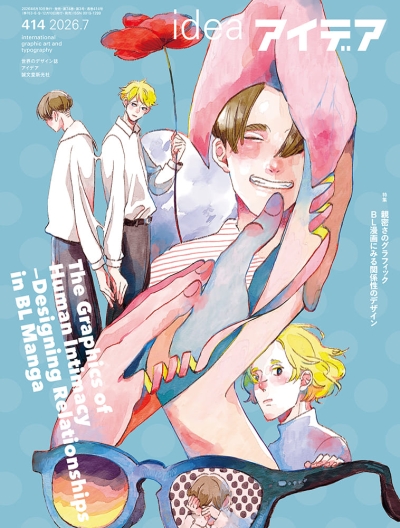
Idea 414. The Graphics of Human Intimacy. Designing Relationships in BL Manga
There is a genre of storytelling in Japan known as BL (which stands for Boysʼ Love, a genre depicting homoerotic relationships between male characters). It has now grown into a massive cultural phenomenon, expanding its scope beyond manga and novels to include anime, video games, fan fiction, and social media culture; yet its form of expression continues to evolve. The BL genre has long been discussed primarily from a storytelling perspective. Why do female manga artists draw relationships between men? Why so many female readers? How do these stories relate to issues of gender and sexuality? Questions like these have been discussed time and time again, creating a rich body of scholarship. However, what of the question about how these ʻrelationshipsʼ have been visualized? This feature article is an attempt to examine BL from a design perspective, with a particular focus on manga.
Examples are ripe for the choosing—compositions conveying distance between two people, gazes meeting, negative space, color, typography, the placement of characters on covers, fingertips not quite touching, back-to-back silhouettes. With BL stories, the relationships themselves are often designed as visual elements. This is more than mere decoration—this is the design of emotion.
We have examined countless BL manga for this feature, and I was struck by the sheer breadth of expression.
The range of style was astonishingly diverse: those that emphasize a subtle vibe, the fashionable and catchy, and even those with a quietness similar to an art book. Yet there was also a certain shared sensibility among them; something more than just making the characters look attractive. There were remnants of contemplations on the best ways to show these interpersonal intimacies. Iʼm not just talking about amorous feelings. Readers also receive a sense of the creatorʼs determination to give form to the relationship itself—tensions, dependence, longing, anxiety, reassurance, and all the other unnameable emotions. Some works emphasize sexual tension, while others meticulously depict ordinary moments in life. Many of the works blur lines between friendship and romance, in attempts to depict “those unnameable moments of intimacy.” These changes are reflected not only in the stories themselves, but also in visual elements, like book design, layout, color schemes, and typography.
Nowadays, depicting an ʻindividualʼ is also a matter of depicting their ʻrelationships.ʼ With social media came a swath of constant
visualizations of who is connected to whom, and the nature of our interactions with others. The BL genre culture has consistently depicted these fluctuations and subtleties of emotions in extremely high resolution.
This feature reveals a wide range of cover designs for BL manga, primarily from 2010 onwards. Our goal is to explore the breadth of expression within this genre through designersʼ comments, interviews with authors, and contributions from researchers. How is intimacy visualized? How do we give visual form to relationships? These inquiries lie within the realm of graphic design. We sincerely hope this feature others a fresh perspective into the BL genre.
Design by LABORATORIES(Kensaku Kato, Sae Kamata, Sakura Koizumi)
Photography by Satoshi Aoyagi
Translation by Duncan Brotherton, Fraze Craze Inc.