







































































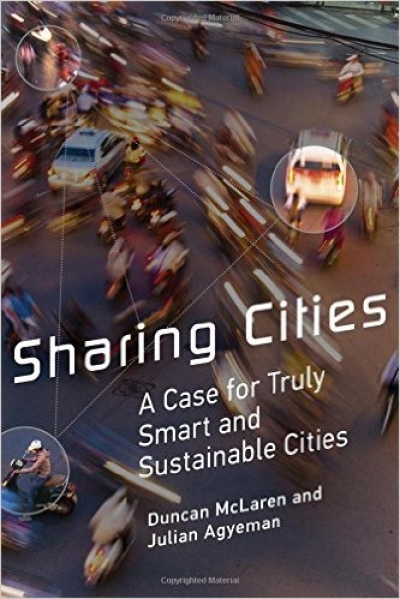
Sharing Cities. A Case for Truly Smart and Sustainable Cities
The future of humanity is urban, and the nature of urban space enables, and necessitates, sharing -- of resources, goods and services, experiences. Yet traditional forms of sharing have been undermined in modern cities by social fragmentation and commercialization of the public realm. In Sharing Cities, Duncan McLaren and Julian Agyeman argue that the intersection of cities' highly networked physical space with new digital technologies and new mediated forms of sharing offers cities the opportunity to connect smart technology to justice, solidarity, and sustainability. McLaren and Agyeman explore the opportunities and risks for sustainability, solidarity, and justice in the changing nature of sharing. McLaren and Agyeman propose a new "sharing paradigm," which goes beyond the faddish "sharing economy" -- seen in such ventures as Uber and TaskRabbit -- to envision models of sharing that are not always commercial but also communal, encouraging trust and collaboration. Detailed case studies of San Francisco, Seoul, Copenhagen, Medellin, Amsterdam, and Bengaluru (formerly Bangalore) contextualize the authors' discussions of collaborative consumption and production; the shared public realm, both physical and virtual; the design of sharing to enhance equity and justice; and the prospects for scaling up the sharing paradigm though city governance. They show how sharing could shift values and norms, enable civic engagement and political activism, and rebuild a shared urban commons. Their case for sharing and solidarity offers a powerful alternative for urban futures to conventional "race-to-the-bottom" narratives of competition, enclosure, and division.