





Direkt zum Inhalt

Warenkorb

  • Laurence A. Rickels

    Ulrike Ottinger. Eine Autobiografie

  • N. John Habraken, Arnulf Lüchinger

    Die Träger und die Menschen. Das Ende des Massenwohnungsbau…

  • gerade nicht auf Lager
    Liz Kotz

    Words to Be Looked at. Language in 1960s Art

  • gerade nicht auf Lager
    Guy Debord

    Comments on the Society of the Spectacle

  • Michel de Certeau

    Kunst des Handelns

  • gerade nicht auf Lager
    Jacques Ranciere

    Ist Kunst widerständig?

  • Alain Badiou

    Wofür steht der Name Sarkozy?

  • gerade nicht auf Lager
    Donna Haraway

    Die Neuerfindung der Natur. Primaten, Cyborgs und Frauen.

  • gerade nicht auf Lager
    Stefanie Schulte Strathaus, Florian…

    Wer sagt denn, dass Beton nicht brennt, hast Du’s probiert?

  • gerade nicht auf Lager
    Henri Lefebvre

    Writings on Cities

  • Loretta Napoleoni

    Rogue Economics. Capitalism's New Reality

  • AD

    AD 174. Vol. 75. Nr. 2. Samantha Hardingham. The 1970'…

  • An Architektur

    An Architektur 18: Camp for Oppositional Architecture:…

  • Johan Frederik Hartle

    Der geöffnete Raum. Zur Politik der ästhetischen Form

  • An Architektur

    An Architektur 16-17

  • Vera Beyer, Jutta Voorhoeve, Anselm…

    Das Bild ist der König. Repräsentation nach Louis Marin

  • An Architektur

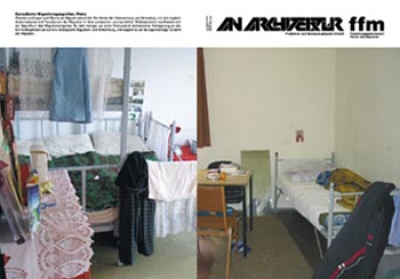
    An Architektur 15 / FFM 11: Europäische…

  • An Architektur

    An Architektur 14: Camp for Oppositional Architecture

  • An Architektur

    An Architektur 11-13: Theorie und Praxis der Kartografie

  • An Architektur

    An Architektur 10: Gemeinschaftsräume

  • An Architektur

    An Architektur 04-09: Krieg und die Produktion von Raum

  • IDEA Magazine

    IDEA 296. Books <preposition> graphic design

  • IDEA Magazine

    IDEA 293. Stanley Donwood / Vacances. DD-DDD / Dimensions…

  • gerade nicht auf Lager
    An Architektur

    An Architektur 01-03

  • Pro qm

    Gutschein / Voucher

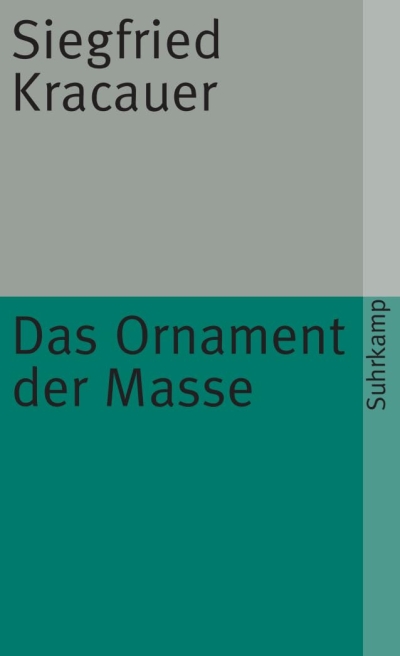
  • Siegfried Kracauer

    Das Ornament der Masse. Essays

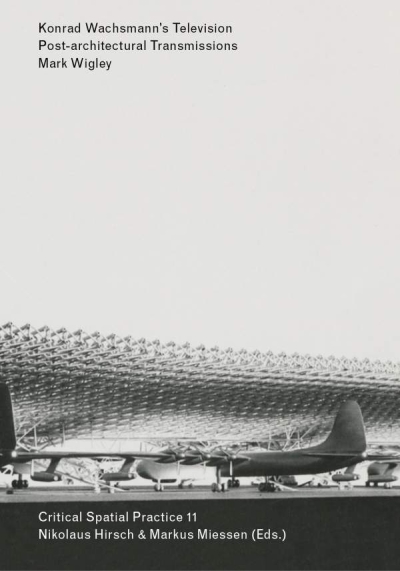
Konrad Wachsmann’s Television. Post-architectural Transmissions

In this provocative intellectual biography, architectural historian Mark Wigley makes the surprising claim that the thinking behind modernist architect Konrad Wachsmann’s legendary projects was dominated by the idea of television. While architecture is typically embarrassed by television, preferring to act as if it never happened, Wachsmann fully embraced it. Investigating the archives of one of the most influential designers of the twentieth century, Wigley scrutinizes Wachsmann’s design, research, and teaching, closely reading a succession of unseen drawings, models, photographs, correspondence, publications, syllabi, reports, and manuscripts to argue that Wachsmann is an anti-architect—a student of some of the most influential designers of the 1920s that dedicated thirty-five post–Second World War years to the disappearance of architecture.
Wachsmann turned architecture against itself. His hypnotic projects for a new kind of space were organized around the thought that television liberates a different way of living together. Wachsmann dissolved buildings into pulsating mirages that were a huge influence on the experimental avant-gardes of the 1960s and 1970s. But "Konrad Wachsmann’s Television: Post-architectural Transmissions" demonstrates that this work was even more extreme than the experiments it inspired. The book offers a forensic analysis of a career to show that Wachsmann developed one of the most compelling manifestos of what architecture would need to become in the age of ubiquitous electronics.


Mark Wigley
Konrad Wachsmann’s Television. Post-architectural Transmissions
Sternberg Press, 2020, 978-3-95679-535-0
gerade nicht auf Lager