








Direkt zum Inhalt

Warenkorb

  • N. John Habraken, Arnulf Lüchinger

    Die Träger und die Menschen. Das Ende des Massenwohnungsbau…

  • gerade nicht auf Lager
    Liz Kotz

    Words to Be Looked at. Language in 1960s Art

  • gerade nicht auf Lager
    Guy Debord

    Comments on the Society of the Spectacle

  • Michel de Certeau

    Kunst des Handelns

  • gerade nicht auf Lager
    Jacques Ranciere

    Ist Kunst widerständig?

  • Alain Badiou

    Wofür steht der Name Sarkozy?

  • gerade nicht auf Lager
    Donna Haraway

    Die Neuerfindung der Natur. Primaten, Cyborgs und Frauen.

  • gerade nicht auf Lager
    Stefanie Schulte Strathaus, Florian…

    Wer sagt denn, dass Beton nicht brennt, hast Du’s probiert?

  • gerade nicht auf Lager
    Henri Lefebvre

    Writings on Cities

  • Loretta Napoleoni

    Rogue Economics. Capitalism's New Reality

  • AD

    AD 174. Vol. 75. Nr. 2. Samantha Hardingham. The 1970'…

  • An Architektur

    An Architektur 18: Camp for Oppositional Architecture:…

  • Johan Frederik Hartle

    Der geöffnete Raum. Zur Politik der ästhetischen Form

  • An Architektur

    An Architektur 16-17

  • Vera Beyer, Jutta Voorhoeve, Anselm…

    Das Bild ist der König. Repräsentation nach Louis Marin

  • An Architektur

    An Architektur 15 / FFM 11: Europäische…

  • An Architektur

    An Architektur 14: Camp for Oppositional Architecture

  • An Architektur

    An Architektur 11-13: Theorie und Praxis der Kartografie

  • An Architektur

    An Architektur 10: Gemeinschaftsräume

  • An Architektur

    An Architektur 04-09: Krieg und die Produktion von Raum

  • IDEA Magazine

    IDEA 296. Books <preposition> graphic design

  • IDEA Magazine

    IDEA 293. Stanley Donwood / Vacances. DD-DDD / Dimensions…

  • gerade nicht auf Lager
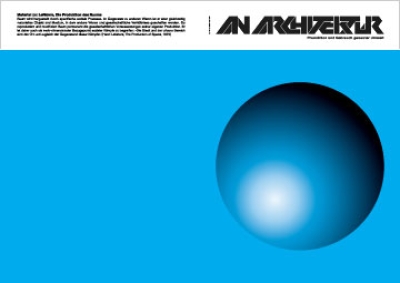
    An Architektur

    An Architektur 01-03

  • Pro qm

    Gutschein / Voucher

  • Siegfried Kracauer

    Das Ornament der Masse. Essays

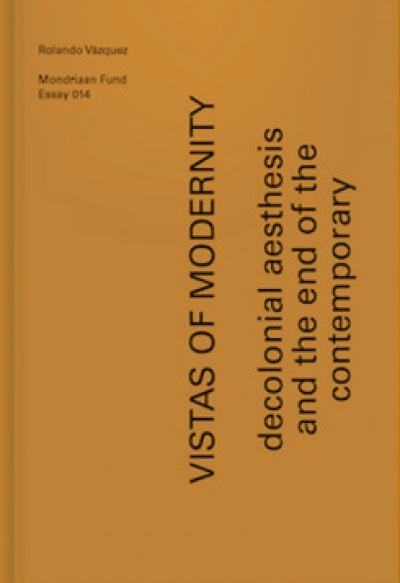
Vistas Of Modernity. Decolonial Aesthesis And The End Of The Contemporary

We are living in a time of polarization. Cultural and educational institutions are confronted with the responsibility to provide tools and spaces for critical reflection, for engagement, and, more fundamentally, for meeting and recognizing each other in our differences. In this decolonial essay Rolando Vázquez introduces his critique which offers an option for thinking and doing beyond the dominant paradigms. It provides a critical analysis of modernity understood broadly as the western project of civilization, while it seeks to overcome the dominion of western epistemology and aesthetics and their embedded eurocentrism and anthropocentrism.
Importantly for decolonial thought we are all located in relation to the colonial difference that structures our modern/colonial order. It is only from an awareness of our positioned realities that we can enter in relation with each-other, that we can listen to each-other and learn each-other.


Rolando Vázquez
Vistas Of Modernity. Decolonial Aesthesis And The End Of The Contemporary
Jap Sam Books, 2020, 978-90-76936-53-6
gerade nicht auf Lager