






















































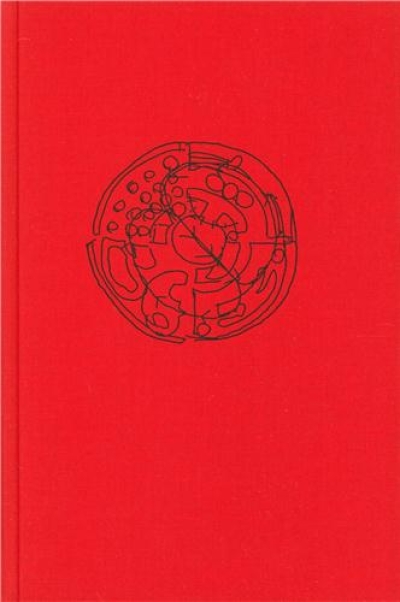












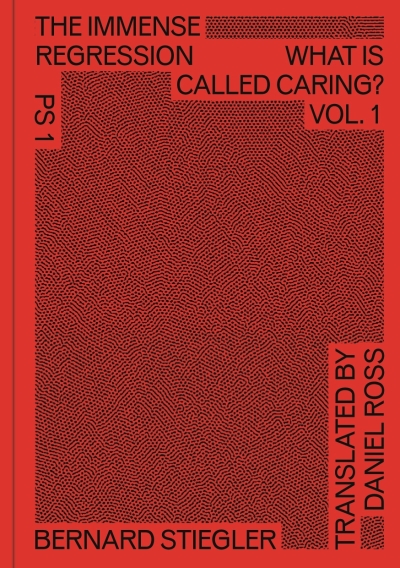
Bernard Stiegler, The Immense Regression: What Is Called Caring? Vol. 1.
Pensées soignées
Did we truly understand Nietzsche when, in 1879, he insisted that philosophy should begin not with astonishment, but with dread? Did we grasp what Félix Guattari foresaw in The Three Ecologies when, in 1989, he warned that a “barbaric implosion” was entirely possible—while also flagging the dangers of a certain businessman named Donald Trump? And have we fully reckoned with what Gilles Deleuze described, just three years before the birth of the World Wide Web, as the arrival of control societies?
Today, as we are engulfed by the so-called Anthropocene event—whose outlines Heidegger once named Gestell—and swept into the despair of post-truth and planetary crisis, it often feels as though thought itself has been rendered powerless. It is too late, we tell ourselves. This time, the delay may be fatal: not only for humanity, but for life in all its forms.
But it is never too late to begin healing.
If thought seems helpless, perhaps it is because it has forgotten how to care—for the world, for others, for itself. What does it mean to think as an act of care? What does it mean to bandage, to tend, to hold open the possibility of recovery?
In The Immense Regression, the first volume of his two-part philosophical opus What Is Called Caring?, Bernard Stiegler returns to the existential question of care as the most urgent task of thinking in the Anthropocene. Masterfully translated by his longtime friend and collaborator Daniel Ross, this is Stiegler at his most provocative, timely, and necessary.
Bernard Stiegler (1952–2020) was a philosopher, founder of the Ars Industrialis group and the online school pharmakon.fr, and director of the Institute for Research and Innovation, which he created within the Centre Pompidou. His research focused on social, political, economic, epistemological, and psychological changes caused by technological and scientific development linked to the “digital revolution.” He was the author of numerous works and considered one of the most influential European philosophers of the twenty-first century.
Daniel Ross obtained his doctorate from Monash University. He is the author of Violent Democracy (2004) and Psychopolitical Anaphylaxis (2021), and has translated many books by Bernard Stiegler into English. He is also the co-director of the prize-winning film The Ister (2004).
Bernard Stiegler, The Immense Regression: What Is Called Caring? Vol. 1. Translated from the French by Daniel Ross for the “Pensées soignées” series, co-edited by Stuart Kendall and Etienne Turpin. Design by K. Verlag with Wolfgang Hückel and Katharina Tauer. Produced with partial support from the Centre national du livre, France.
Pensées soignées