



























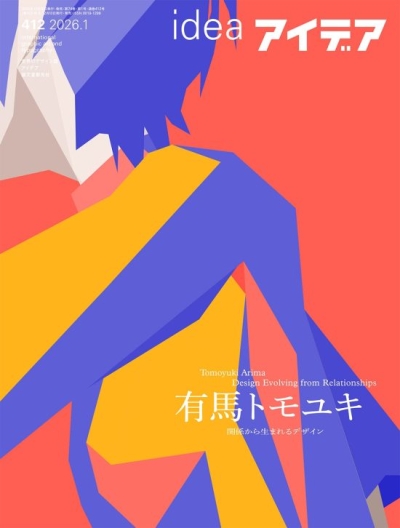
Idea 412. Tomoyuki Arima: Design Evolving from Relationships
Direction by Toshinobu Nagata & Idea
Design by LABORATORIES(Kensaku Kato, Sae Kamata, Sakura Koizumi)
The state of technology has persistently played a large part in influencing design and designers. Applications once the domain of specialists with technical training are now improved, offering more advanced functionality and also more intuitive and accessible than ever. Now anyone can produce any kind of graphics, regardless of their educational background.
On the other hand, unease surrounding the rapid advance of automated technology is spreading, as evidenced by the fierce debates over the merits of AI technology. If we all use the same applications with the same technical support, will everything end up looking the same? Rather than adjusting technology to suit humans, it is as though humans are being adjusted to suit technology. We may be headed towards design (or designer) dystopia like this.
Tomoyuki Arima (of Arima Design Institute at the Nippon Design Center) has kept real-time pace with digital innovation since 2000. He has no specialized design education from any art university. He absorbed games and the internet through computers, discovered manga and anime culture on the web, learned graphic design through music, met people through dojin design, and continuously expanded his professional domain through interaction. Web, books, packaging, branding, animation, games, exhibitions—he has constantly explored for the connections between technology and people, and has made liberal use of applications as though they were readily-available tools.
This feature is a summary of Tomoyuki Arima’s career. Arima has consistently created designs from the relationships between technology and people. Rather than defining his professional scope by any given occupational ability, he has established the domain of his work through each project depending on the demand (or lack thereof); all driven by his own motivation. It’s not about where design ends: it’s about what design includes. He exerts himself not as a designer, but as someone capable of design. This approach inspires project associates, blurs the boundaries between client and designer, supersedes style, and defines what is Tomoyuki Arima Design.
Reviewing Arima’s work has prompted us to reexamine the relationship between technology and design in the modern era. It has also shifted our gaze to the ‘human’ element that must exist for design to remain human endeavor: an element that should serve as a guiding principle for designers headed into the 2030s. We hope this feature will provide encouragement to all aspiring designers.