


Direkt zum Inhalt

Warenkorb

  • Oxana Gourinovitch

    Raising the Curtain. Operatic Modernism and the Soviet…

  • gerade nicht auf Lager
    Lydia Kallipoliti

    Histories of Ecological Design. An Unfinished Cyclopedia

  • Anders Engberg-Pedersen

    Martialische Ästhetik

  • gerade nicht auf Lager
    Matthias Ballestrem, Katharina Benjamin…

    Constructive Disobedience

  • gerade nicht auf Lager
    Sofie De Caigny, Hülya Ertas, Bie…

    As Found. Experiments in Preservation

  • !Mediengruppe Bitnik, Janez Fakin Janša

    (un)real data ☁️ – (🧊)real effects

  • Docomomo International (Ed)

    Modernism in Africa

  • gerade nicht auf Lager
    Daniela Hamaui (Ed.)

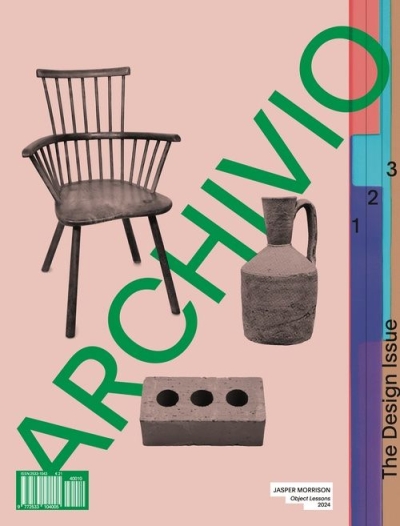
    Archivio Magazine N°10. The Design Issue

  • gerade nicht auf Lager
    Derk Loorbach, Véronique Patteeuw, Léa-…

    It's About Time. The Architecture of Climate Change

  • Noemi Biasetton

    Superstorm

  • gerade nicht auf Lager
    Steven Henry Madoff

    Why I Do What I Do - Global Curators Speak

  • Leopoldina Fortunati, Carla Lonzi

    Folio G: Gendered Labour and Clitoridean Revolt

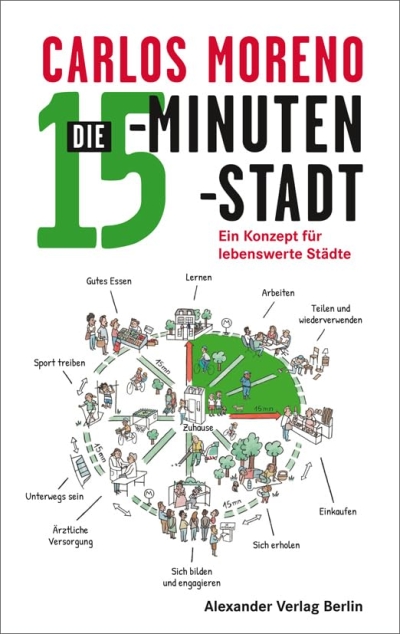
  • Carlos Moreno

    Die 15-Minuten-Stadt. Ein Konzept für lebenswerte Städte

  • Julian Rose

    Building Culture

  • gerade nicht auf Lager
    Charlotte Malterre-Barthes (Ed.)

    On Architecture and the Greenfield

  • gerade nicht auf Lager
    Ulrike Brückner, Bianca Herlo

    Design als Haltung. Handlungsfelder jenseits des…

  • Folke Köbberling

    WOLLBAU. Wolle - Eine unterschätzte Ressource.

  • Melanie Franke (Hg.)

    Selbsterzählungen und Umbruchspuren im Œuvre von Künstler:…

  • gerade nicht auf Lager
    Stellan Gulde (Ed.)

    Banal Buildings. Anthology

  • gerade nicht auf Lager
    Franz Liebl

    Steakholder Management. Bausteine eines Culinary Turn in…

  • Urszula Kozminska, Nacho Ruiz Allen

    Time Matters

  • gerade nicht auf Lager
    Anja Kaiser, Rebecca Stephany

    Glossary of Undisciplined Design

  • gerade nicht auf Lager
    Ursula K. Le Guin

    Steering the Craft. A Twenty-First-Century Guide to Sailing…

  • Helmut Draxler

    Was tun? Was lassen? Politik als symbolische Form

  • Enzo Traverso

    Gaza im Auge der Geschichte

  • gerade nicht auf Lager
    Gene Ray

    After the Holocene. Planetary Politics for Commoners

  • Paolo Cirio

    Climate Tribunal. Fossil Fuels Industry on Trial

  • சிந்துஜன் வரதராஜா (Sinthujan…

    Hierarchien der Solidarität. Hierarchies of Solidarity.

  • gerade nicht auf Lager
    Simon O'Sullivan

    From Magic and Myth-Work to Care and Repair

  • gerade nicht auf Lager
    André Tavares

    Architecture Follows Fish. An Amphibious History of the…

  • Daniela Comani

    You Are Mine

  • Friedrich von Borries

    Architektur im Anthropozän. Eine spekulative Archäologie

  • Lisa Luksch, Andres Lepik (ed.)

    Reading Visual Investigations. Between Advocacy, Journalism…

  • gerade nicht auf Lager
    Jeppe Ugelvig (Ed.)

    Viscose Journal 07. Scent

  • George MacBeth

    e-flux Index #3

  • Kateryna Malaia, Philipp Meuser

    Mass Housing in Ukraine. Building Typologies and Catalogue…

  • Kirsten Wagner (Hg.)

    Theorien des Wohnens. Eine Kommentierte Anthologie

  • Susanne Schmid, Dietmar Eberle, Margit…

    Eine Geschichte des gemeinschaftlichen Wohnens. Modelle des…

  • gerade nicht auf Lager
    Yuk Hui

    Machine and Sovereignty. For a Planetary Thinking

  • Irene Fantappiè, Francesco Giusti,…

    Rethinking Lyric Communities

  • gerade nicht auf Lager
    Christoph Ramisch (Ed.)

    Daidalos Nr 23-24

  • gerade nicht auf Lager
    Nicolas Linnert (ed.)

    Hervé Guibert. Suzanne and Louise

  • Giorgi Vachnadze

    Christian Eschatology of Artificial Intelligence: Pastoral…

  • gerade nicht auf Lager
    0nty & OnMyComputer (Eds.)

    Dialogues on CoreCore & the Contemporary Online Avant-…

  • Nicholas E. Powers (ed.)

    Where does a body begin? Biology's function in…

  • Alessandro Sbordoni

    Semiotics of the End: Essays on Capitalism and the…

  • gerade nicht auf Lager
    Jill Johnston, Clare Croft (ed.)

    The Essential Jill Johnston Reader

  • Anna-Sophie Springer, Raul Walch (eds.)

    Owned by Others: A Map to Possession Island

  • Canadian Centre for Architecture

    AP 205 Amancio Williams: Readings of the Archive

  • Clothilde Morette, Victoria Aresheva (…

    Science/Fiction. A Non-History of Plants

  • Ulrich Heinke

    Ulrich Heinke. Schlot

  • gerade nicht auf Lager
    Richard Sennett

    Democracy and Urban Form

  • Hilde Strobl, Peter Cachola Schmal,…

    Einfach Grün - Greening the City

  • gerade nicht auf Lager
    Niekolaas Johannes Lekkerkerk, Eva…

    Worlding Ecologies. Art, Science and Activism Towards…

  • Yuk Hui

    Post-Europe

  • Gabu Heindl, Drehli Robnik

    Nonsolution. Zur Politik der aktiven Nichtlösung im Planen…

  • Ignacio Farías, Felix Marlow, Rebecca…

    Zaudern ums Gemeinwohl. Produktive Missverständnisse in der…

  • gerade nicht auf Lager
    Ian Erickson, Tomi Laja

    Disc Journal. Issue 3.0 "Enchantment"

  • gerade nicht auf Lager
    Estelle Hoy, edited by Antonia Carrara

    Estelle Hoy. saké blue. Selected Writings

  • gerade nicht auf Lager
    Nick Mauss, Edited by Antonia Carrara…

    Nick Mauss. Dispersed Events. Selected Writings

  • gerade nicht auf Lager
    Clémence Imbert

    Manifestes 7. Why History Matters to Graphic Design

  • dérive

    dérive N° 97, Energie (Okt-Dez 2024).

  • Christina Landbrecht

    Künstlerische Forschung. Potenziale, Probleme, Perspektiven

  • bell hooks

    Kritisch denken lernen. Erkenntnisse aus der Praxis

  • Raafat Majzoub (ed.)

    Beyond Ruins. Reimagining Modernism

  • gerade nicht auf Lager
    Holm-Uwe Burgemann (Hg.)

    Neue Erschöpfungsgeschichten

  • Anne Kockelkorn, Susanne Schindler,…

    Cooperative Conditions. A Primer on Architecture, Finance…

  • Anne Lacaton, Jean-Philippe Vassal

    Lacaton & Vassal. It's Nice Today: On Climate,…

  • Bjørn Hegardt (Ed.)

    FUKT #22 – The Nature Issue

  • Guido Neubeck, Professur für Entwerfen…

    Schulbaukörper

  • gerade nicht auf Lager
    Bianca Felcori (Ed.)

    Forgotten Architecture. An Archive of Overshadowed Projects

  • gerade nicht auf Lager
    Marouane Bakhti

    How to Leave the World

  • gerade nicht auf Lager
    Jan Steinbach, Justine Stella Knuchel (…

    Hold The Sound. Notes On Auditories

  • gerade nicht auf Lager
    Ijlal Muzaffar

    Modernism's Magic Hat - Architecture and the Illusion…

  • Paloma Checa-Gismero

    Biennial Boom. Making Contemporary Art Global

  • Sarah Blacker, Emily Brownell, Anindita…

    The Planning Moment. Colonial and Postcolonial Histories

  • Andreas Reckwitz

    Verlust. Ein Grundproblem der Moderne

  • Eva Illouz

    Explosive Moderne

  • Magdalena Taube, Krystian Woznicki

    kin city. Urbane Ökologien, Infrastrukturen des Lebens und…

  • Guillermo Rubio Boronat, Javier Villar…

    Kengo Kuma. Arquitectura Urbana 2006--2024. TC Cuadernos…

  • Pierre-Héli Monot, David Bebnowski,…

    Activist Writing. History, Politics, Rhetoric (Mono 02)

  • Annie Bourneuf

    Im Rücken des Engels der Geschichte

  • Kathrin Wildner, metroZones

    metroZine #1. Reading the Map. Anleitung zum Kartenlesen

  • Christian Hanussek, metroZones

    metroZine #2. Die Tapete als Parergon – und Methode

  • Anne Huffschmid, metroZones

    metroZine #3. Das Atmen der Bilder. Schwarze Löcher und…

  • gerade nicht auf Lager
    Ian Trowell

    Throbbing Gristle. An Endless Discontent

  • Sandra Hofmeister

    Bauen im Bestand. Wohnen / Building in Existing Contexts.…

  • Jon Dowling

    Monogram Logo. Trademarks & Symbols

  • Domen Ograjensek

    Restricting Flight Surreptitious Assembly. The Diagrammatic…

  • Steffen Köhn, Nestor Siré

    Handmade Networks

  • Daphne Dragona, Domenico Quaranta (eds.)

    The Postscriptum Anthology (2010 - 2023). Essays on Art,…

  • Rafael Schacter

    Monumental Graffiti. Tracing Public Art and Resistance in…

  • Fernanda Canales

    My House, Your City. Privacy in a Shared World

  • gerade nicht auf Lager
    Thomas Durisch

    Peter Zumthor 1985-2013. Bauten und Projekte

  • gerade nicht auf Lager
    VOLUPTAS ETHZ, Chair Charbonnet/Heiz (…

    Elegies. Laments for an architectural project

  • Robert Jan van Pelt

    The Barrack. 1572-1914. Chapters in the History of…

  • gerade nicht auf Lager
    Aaron Forrest, Yasmin Vobis, Brett…

    Heterogeneous Constructions. Studies in Mixed Material…

  • Arch+ Zeitschrift für Architektur und…

    Arch+ 257. Umbau. Maßstäbe der Transformation

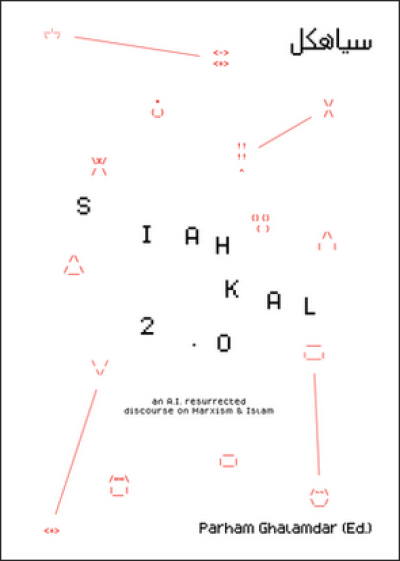
SIAHKAL 2.0: An A.I. resurrected discourse on Marxism & Islam


Siahkal names a place in the forests of Gilan and a threshold in revolutionary time. In 1971 a guerrilla action near Siahkal shook the order of the Shah. The action failed militarily yet seeded a myth for the People’s Fedai Guerrillas. Bizhan Jazani, a founding thinker, wrote and painted in prison and was executed in 1975. His work teaches that strategy rather than sentiment endures. // This book treats Siahkal as a Deep Object, a persistent attractor that gathers memory, images, and tactics. An AI model trained on Jazani’s writings and paintings translates his essay on Islamic Marxism and proposes annotations. The machine functions as a probe that widens attention while remaining accountable to the source. Parham Ghalamdar trained the AI, wrote the introduction, and composed ASCII diagrams and diagrammatic readings from Jazani’s artworks. Parsa Esmaeilzadeh contributes an essay that reads Jazani through Karatani and left accelerationism. // It is a call to reimagine and export revolution as a Deep Object that asks for Deep Time to unfold. This clandestine edition invites the reader to study, test, and build strategy that can outlast the news cycle and meet the future head on.

This is a limited edition book. The author trained an LLM on the texts of a deceased theorist, and then proceeded to interact with the LLM and produce simulations of what the theorist may have said in regards to various pertinent topics. The book is primarily a free online resource, but a few copies are being printed to commemorate the work. It has a foreword and afterword by the Editors.

At the core of this project is a translation of “Marxist Islam or Islamic Marxism,” a groundbreaking text written by Bizhan Jazani during his imprisonment in the 1970s under the Shah’s oppressive regime. Translated by Parham Ghalamdar, this work is accompanied by an introduction contextualizing Jazani’s radical vision. Ghalamdar also contributes a series of ASCII-style illustrations and diagrams—AI-assisted reinterpretations of Jazani’s original paintings and photographs—that bridge the past and present, offering a new perspective on his revolutionary artistry.


About the author
Parham Ghalamdar is a multidisciplinary artist currently based in the UK. Ghalamdar’s work traces forgotten mythologies, buried philosophies, and visual ruins, reconfiguring them into speculative worlds where memory, fiction, and futurism collapse into one another. Drawing on cybernetic theory and generative AI, he explores how systems of feedback, simulation, and machine vision mediate our understanding of history and possibility. Through painting, film, and writing, he builds narratives that feel both ancient and yet-to-come, haunted by lost histories and animated by possible futures.


Siahkal
names a place in the forests of Gilan and a threshold in revolutionary
time. In 1971 a guerrilla action near Siahkal shook the order of the
Shah. The action failed militarily yet seeded a myth for the People’s
Fedai Guerrillas. Bizhan Jazani, a founding thinker, wrote and painted
in prison and was executed in 1975. His work teaches that strategy
rather than sentiment endures. // This book treats Siahkal as a Deep
Object, a persistent attractor that gathers memory, images, and tactics.
An AI model trained on Jazani’s writings and paintings translates his
essay on Islamic Marxism and proposes annotations. The machine functions
as a probe that widens attention while remaining accountable to the
source. Parham Ghalamdar trained the AI, wrote the introduction, and
composed ASCII diagrams and diagrammatic readings from Jazani’s
artworks. Parsa Esmaeilzadeh contributes an essay that reads Jazani
through Karatani and left accelerationism. // It is a call to reimagine
and export revolution as a Deep Object that asks for Deep Time to
unfold. This clandestine edition invites the reader to study, test, and
build strategy that can outlast the news cycle and meet the future head
on.


This is a limited edition book. The author trained an LLM on the texts
of a deceased theorist, and then proceeded to interact with the LLM and
produce simulations of what the theorist may have said in regards to
various pertinent topics. The book is primarily a free online resource,
but a few copies are being printed to commemorate the work. It has a
foreword and afterword by the Editors.


At the core of this project is a translation of “Marxist Islam or
Islamic Marxism,” a groundbreaking text written by Bizhan Jazani during
his imprisonment in the 1970s under the Shah’s oppressive regime.
Translated by Parham Ghalamdar, this work is accompanied by an
introduction contextualizing Jazani’s radical vision. Ghalamdar also
contributes a series of ASCII-style illustrations and
diagrams—AI-assisted reinterpretations of Jazani’s original paintings
and photographs—that bridge the past and present, offering a new
perspective on his revolutionary artistry.


About the author

Parham Ghalamdar is a multidisciplinary artist currently based in the
UK. Ghalamdar’s work traces forgotten mythologies, buried philosophies,
and visual ruins, reconfiguring them into speculative worlds where
memory, fiction, and futurism collapse into one another. Drawing on
cybernetic theory and generative AI, he explores how systems of
feedback, simulation, and machine vision mediate our understanding of
history and possibility. Through painting, film, and writing, he builds
narratives that feel both ancient and yet-to-come, haunted by lost
histories and animated by possible futures.


Siahkal
names a place in the forests of Gilan and a threshold in revolutionary
time. In 1971 a guerrilla action near Siahkal shook the order of the
Shah. The action failed militarily yet seeded a myth for the People’s
Fedai Guerrillas. Bizhan Jazani, a founding thinker, wrote and painted
in prison and was executed in 1975. His work teaches that strategy
rather than sentiment endures. // This book treats Siahkal as a Deep
Object, a persistent attractor that gathers memory, images, and tactics.
An AI model trained on Jazani’s writings and paintings translates his
essay on Islamic Marxism and proposes annotations. The machine functions
as a probe that widens attention while remaining accountable to the
source. Parham Ghalamdar trained the AI, wrote the introduction, and
composed ASCII diagrams and diagrammatic readings from Jazani’s
artworks. Parsa Esmaeilzadeh contributes an essay that reads Jazani
through Karatani and left accelerationism. // It is a call to reimagine
and export revolution as a Deep Object that asks for Deep Time to
unfold. This clandestine edition invites the reader to study, test, and
build strategy that can outlast the news cycle and meet the future head
on.


This is a limited edition book. The author trained an LLM on the texts
of a deceased theorist, and then proceeded to interact with the LLM and
produce simulations of what the theorist may have said in regards to
various pertinent topics. The book is primarily a free online resource,
but a few copies are being printed to commemorate the work. It has a
foreword and afterword by the Editors.


At the core of this project is a translation of “Marxist Islam or
Islamic Marxism,” a groundbreaking text written by Bizhan Jazani during
his imprisonment in the 1970s under the Shah’s oppressive regime.
Translated by Parham Ghalamdar, this work is accompanied by an
introduction contextualizing Jazani’s radical vision. Ghalamdar also
contributes a series of ASCII-style illustrations and
diagrams—AI-assisted reinterpretations of Jazani’s original paintings
and photographs—that bridge the past and present, offering a new
perspective on his revolutionary artistry.


About the author

Parham Ghalamdar is a multidisciplinary artist currently based in the
UK. Ghalamdar’s work traces forgotten mythologies, buried philosophies,
and visual ruins, reconfiguring them into speculative worlds where
memory, fiction, and futurism collapse into one another. Drawing on
cybernetic theory and generative AI, he explores how systems of
feedback, simulation, and machine vision mediate our understanding of
history and possibility. Through painting, film, and writing, he builds
narratives that feel both ancient and yet-to-come, haunted by lost
histories and animated by possible futures.


Siahkal names a place in the forests of Gilan and a threshold in revolutionary time. In 1971 a guerrilla action near Siahkal shook the order of the Shah. The action failed militarily yet seeded a myth for the People’s Fedai Guerrillas. Bizhan Jazani, a founding thinker, wrote and painted in prison and was executed in 1975. His work teaches that strategy rather than sentiment endures. // This book treats Siahkal as a Deep Object, a persistent attractor that gathers memory, images, and tactics. An AI model trained on Jazani’s writings and paintings translates his essay on Islamic Marxism and proposes annotations. The machine functions as a probe that widens attention while remaining accountable to the source. Parham Ghalamdar trained the AI, wrote the introduction, and composed ASCII diagrams and diagrammatic readings from Jazani’s artworks. Parsa Esmaeilzadeh contributes an essay that reads Jazani through Karatani and left accelerationism. // It is a call to reimagine and export revolution as a Deep Object that asks for Deep Time to unfold. This clandestine edition invites the reader to study, test, and build strategy that can outlast the news cycle and meet the future head on.

This is a limited edition book. The author trained an LLM on the texts of a deceased theorist, and then proceeded to interact with the LLM and produce simulations of what the theorist may have said in regards to various pertinent topics. The book is primarily a free online resource, but a few copies are being printed to commemorate the work. It has a foreword and afterword by the Editors. 

At the core of this project is a translation of “Marxist Islam or Islamic Marxism,” a groundbreaking text written by Bizhan Jazani during his imprisonment in the 1970s under the Shah’s oppressive regime. Translated by Parham Ghalamdar, this work is accompanied by an introduction contextualizing Jazani’s radical vision. Ghalamdar also contributes a series of ASCII-style illustrations and diagrams—AI-assisted reinterpretations of Jazani’s original paintings and photographs—that bridge the past and present, offering a new perspective on his revolutionary artistry.


“Bizhan Jazani”, Parham Ghalamdar
SIAHKAL 2.0: An A.I. resurrected discourse on Marxism & Islam
Becoming Press, 2025, 978-9925-8207-7-1
15,00 €