










Direkt zum Inhalt

Warenkorb

  • Grada Kilomba

    Plantation Memories. Episodes of Everyday Racism

  • An Architektur

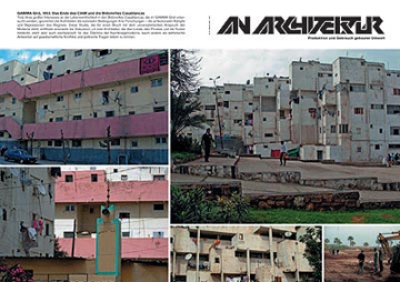
    An Architektur 22: GAMMA Grid, 1953. Das Ende des CIAM und…

  • An Architektur

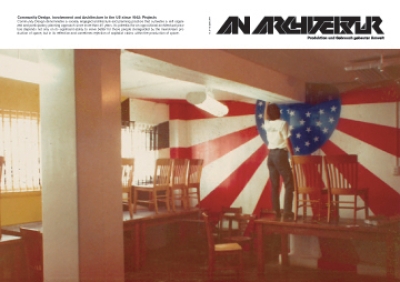
    An Architektur 19-21: Community Design. Involvement and…

  • Antonio Negri

    The Porcelain Workshop. For a New Grammar of Politics

  • Christoph Schaub, Michael Schindhelm

    Bird's Nest (DVD, 87 min.). Jacques Herzog und Pierre…

  • Laurence A. Rickels

    Ulrike Ottinger. Eine Autobiografie

  • N. John Habraken, Arnulf Lüchinger

    Die Träger und die Menschen. Das Ende des Massenwohnungsbau…

  • gerade nicht auf Lager
    Guy Debord

    Comments on the Society of the Spectacle

  • Michel de Certeau

    Kunst des Handelns

  • Alain Badiou

    Wofür steht der Name Sarkozy?

  • gerade nicht auf Lager
    Donna Haraway

    Die Neuerfindung der Natur. Primaten, Cyborgs und Frauen.

  • gerade nicht auf Lager
    Stefanie Schulte Strathaus, Florian…

    Wer sagt denn, dass Beton nicht brennt, hast Du’s probiert?

  • gerade nicht auf Lager
    Henri Lefebvre

    Writings on Cities

  • Loretta Napoleoni

    Rogue Economics. Capitalism's New Reality

  • AD

    AD 174. Vol. 75. Nr. 2. Samantha Hardingham. The 1970…

  • An Architektur

    An Architektur 18: Camp for Oppositional Architecture:…

  • Johan Frederik Hartle

    Der geöffnete Raum. Zur Politik der ästhetischen Form

  • Jörg Dünne, Stephan Günzel (Hg.)

    Raumtheorie. Grundlagentexte aus Philosophie und…

  • An Architektur

    An Architektur 16-17

  • Vera Beyer, Jutta Voorhoeve, Anselm…

    Das Bild ist der König. Repräsentation nach Louis Marin

  • An Architektur

    An Architektur 15 / FFM 11: Europäische…

  • Orhan Esen, Stephan Lanz (Hg)

    Self Service City. Istanbul (metrozones 4)

  • An Architektur

    An Architektur 14: Camp for Oppositional Architecture

  • Stephan Lanz (Hg.)

    City of COOP. Ersatzökonomiern und städtische Bewegungen in…

  • An Architektur

    An Architektur 11-13: Theorie und Praxis der Kartografie

  • An Architektur

    An Architektur 10: Gemeinschaftsräume

  • Jochen Becker, Stephan Lanz (Hg.)

    Space//Troubles. Jenseits des Guten Regierens:…

  • Sarai media lab

    Sarai Reader 03: shaping technologies

  • An Architektur

    An Architektur 04-09: Krieg und die Produktion von Raum

  • IDEA Magazine

    IDEA 296. Books <preposition> graphic design

  • IDEA Magazine

    IDEA 293. Stanley Donwood / Vacances. DD-DDD / Dimensions…

  • gerade nicht auf Lager
    An Architektur

    An Architektur 01-03

  • Martina Löw

    Raumsoziologie

  • Pro qm

    Gutschein / Voucher

  • Brian O'Doherty

    In der weissen Zelle. Inside the White Cube

  • Siegfried Kracauer

    Das Ornament der Masse. Essays

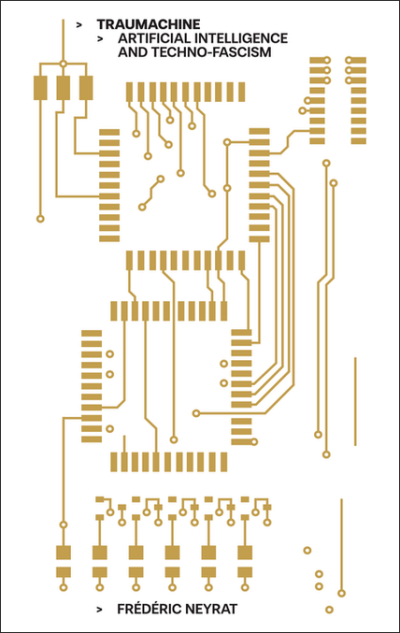
Traumachine. Artificial Intelligence and Techno-Fascism

Humanity is panicking, traumatized by the proliferation of AI, drones, automated decision making, and the general dissolution of institutions that act as pillars of the world we live in. This trauma, however, also extends to the capitalist machine—which appears to be disentangling itself, or becoming detached from reality—and is producing absurd objects in a state of distress. 

“The machine,” as we know it, has no access to the world in such a way that would align with Freud’s understanding of trauma as the “white hole” at the heart of the unconscious. Yet, Frédéric Neyrat, going beyond Freud, grants the capacity for trauma to all beings—whether rocks, trees or animals—arguing that trauma is the very condition for existence, as taking a form comes at the cost of discarding everything else. 

Perhaps the question is not “what must we add to AI for it to be conscious?” but rather “what must be taken away?” Calling it the amachine (l’amachine), Neyrat explores this idea of a machine that had undergone sufficient traumatization for it to constitute a form of intelligence, one which differentiates from human and mechanical, offering thusly a counter-image to the narratives of silicon valley. This is a machine that lacks.

Traumachine challenges both neo-Luddite and accelerationist inclinations, seeking out a different strategy vis-a-vis AI and other ontological generation machines: machines that produce and schematize reality. While resisting the call to merely “smash the machines,” Neyrat concedes no ground to the tech-accelerationist narratives of Musk and Thiel, warning us that completely giving over the tasks of thinking, imagining and communicating to automated processes risks the emergence of artificial fascism.

Having spent many years developing a method he calls exophilosophy—a synthesis of critical analysis and poetics—Neyrat uses cut-up prose, parables and micro-fictions to disrupt the language of AI at the level of grammar. In this case, Traumachine sets prophecy against prediction in the form of a book that is part political analysis, part philosophical fiction and in part a practical proposal for living with the machines we already have.

We're told we have never had so much at our fingertips. So why do we feel so awful? Traumachine cuts to the quick of our modern existential condition: the more our world is populated by machines, the less we seem to be thinking. Neyrat rattles our techno-fascist cage to wake us from our digitalized zombie state. Ignore this book at your peril. 
— Andrew Culp, author of Dark Deleuze— Andrew Culp, author of Dark Deleuze


Frédéric Neyrat
Traumachine. Artificial Intelligence and Techno-Fascism
Becoming Press, 2026, 978-9925-647-15-6
16,00 €