























Direkt zum Inhalt

Warenkorb

  • gerade nicht auf Lager
    Stefanie Schulte Strathaus, Florian…

    Wer sagt denn, dass Beton nicht brennt, hast Du’s probiert?

  • gerade nicht auf Lager
    Henri Lefebvre

    Writings on Cities

  • Loretta Napoleoni

    Rogue Economics. Capitalism's New Reality

  • AD

    AD 174. Vol. 75. Nr. 2. Samantha Hardingham. The 1970…

  • An Architektur

    An Architektur 18: Camp for Oppositional Architecture:…

  • Johan Frederik Hartle

    Der geöffnete Raum. Zur Politik der ästhetischen Form

  • Jörg Dünne, Stephan Günzel (Hg.)

    Raumtheorie. Grundlagentexte aus Philosophie und…

  • An Architektur

    An Architektur 16-17

  • Vera Beyer, Jutta Voorhoeve, Anselm…

    Das Bild ist der König. Repräsentation nach Louis Marin

  • An Architektur

    An Architektur 15 / FFM 11: Europäische…

  • Orhan Esen, Stephan Lanz (Hg)

    Self Service City. Istanbul (metrozones 4)

  • An Architektur

    An Architektur 14: Camp for Oppositional Architecture

  • Stephan Lanz (Hg.)

    City of COOP. Ersatzökonomiern und städtische Bewegungen in…

  • An Architektur

    An Architektur 11-13: Theorie und Praxis der Kartografie

  • An Architektur

    An Architektur 10: Gemeinschaftsräume

  • Jochen Becker, Stephan Lanz (Hg.)

    Space//Troubles. Jenseits des Guten Regierens:…

  • Sarai media lab

    Sarai Reader 03: shaping technologies

  • An Architektur

    An Architektur 04-09: Krieg und die Produktion von Raum

  • IDEA Magazine

    IDEA 296. Books <preposition> graphic design

  • IDEA Magazine

    IDEA 293. Stanley Donwood / Vacances. DD-DDD / Dimensions…

  • gerade nicht auf Lager
    An Architektur

    An Architektur 01-03

  • Martina Löw

    Raumsoziologie

  • Pro qm

    Gutschein / Voucher

  • Brian O'Doherty

    In der weissen Zelle. Inside the White Cube

  • gerade nicht auf Lager
    Siegfried Kracauer

    Das Ornament der Masse. Essays

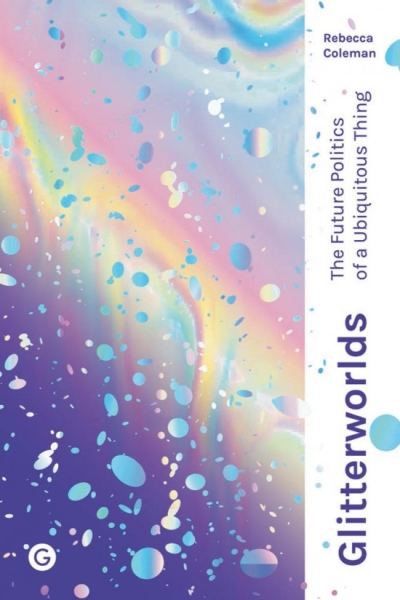
Glitterworlds. The Future Politics of a Ubiquitous Thing

An original examination of the ubiquity of glitter—from bodily adornment to activist glitter bombing—and its vibrant and transformational properties.
Glitter is everywhere, from crafting to makeup, from vagazelling to glitter-bombing, from fashion to fish. Glitter also gets everywhere. It sticks to what it is and isn't supposed to, and travels beyond its original uses, eliciting reactions ranging from delight to irritation.
In Glitterworlds, Rebecca Coleman examines this ubiquity of glitter, following it as it moves across different popular cultural worlds and exploring its effect on understandings and experiences of gender, sexuality, class and race. Coleman investigates how girls engage with glitter in collaging workshops to imagine their futures; how glitter can adorn the outside and the inside of the body; how glitter features in the films Glitter and Precious; and how LGBTQ* activists glitter bomb homophobic and transphobic people.
Throughout, Coleman attends to the plurality of politics that glitter generates, approaching this through the concepts of hope, wonder, fabulation, and prefigurative politics—all of which indicate the making of different, better worlds, although often not in ways that are straightforward or conventional. She develops an original account of future politics, where time is nonlinear and sometimes non-progressive. Coleman's argument brings together feminist cultural theory, feminist new materialisms, and theories on futures and temporality, in order to propose that we should understand glitter as a thing—vibrant, processual, transformational, and traversing boundaries between media and material, culture and nature, bodies and environments.


Rebecca Coleman
Glitterworlds. The Future Politics of a Ubiquitous Thing
Goldsmiths Press, 2020, 9781912685387
29,50 €