





Direkt zum Inhalt

Warenkorb

  • gerade nicht auf Lager
    Donna Haraway

    Die Neuerfindung der Natur. Primaten, Cyborgs und Frauen.

  • gerade nicht auf Lager
    Stefanie Schulte Strathaus, Florian…

    Wer sagt denn, dass Beton nicht brennt, hast Du’s probiert?

  • gerade nicht auf Lager
    Henri Lefebvre

    Writings on Cities

  • Loretta Napoleoni

    Rogue Economics. Capitalism's New Reality

  • AD

    AD 174. Vol. 75. Nr. 2. Samantha Hardingham. The 1970'…

  • An Architektur

    An Architektur 18: Camp for Oppositional Architecture:…

  • Johan Frederik Hartle

    Der geöffnete Raum. Zur Politik der ästhetischen Form

  • An Architektur

    An Architektur 16-17

  • Vera Beyer, Jutta Voorhoeve, Anselm…

    Das Bild ist der König. Repräsentation nach Louis Marin

  • An Architektur

    An Architektur 15 / FFM 11: Europäische…

  • An Architektur

    An Architektur 14: Camp for Oppositional Architecture

  • An Architektur

    An Architektur 11-13: Theorie und Praxis der Kartografie

  • An Architektur

    An Architektur 10: Gemeinschaftsräume

  • An Architektur

    An Architektur 04-09: Krieg und die Produktion von Raum

  • IDEA Magazine

    IDEA 296. Books <preposition> graphic design

  • IDEA Magazine

    IDEA 293. Stanley Donwood / Vacances. DD-DDD / Dimensions…

  • gerade nicht auf Lager
    An Architektur

    An Architektur 01-03

  • Pro qm

    Gutschein / Voucher

  • Siegfried Kracauer

    Das Ornament der Masse. Essays

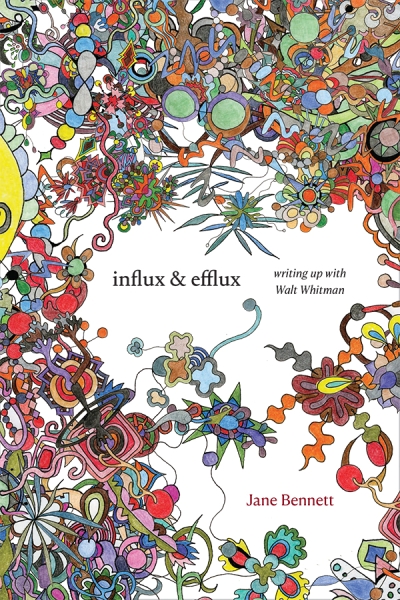
Influx & Efflux. Writing up with Walt Whitman

In "influx & efflux" Jane Bennett pursues a question that was bracketed in her book "Vibrant Matter": how to think about human agency in a world teeming with powerful nonhuman influences? “Influx & efflux”—a phrase borrowed from Whitman's "Song of Myself"—refers to everyday movements whereby outside influences enter bodies, infuse and confuse their organization, and then exit, themselves having been transformed into something new. How to describe the human efforts involved in that process? What kinds of “I” and “we” can live well and act effectively in a world of so many other lively materialities? Drawing upon Whitman, Thoreau, Caillois, Whitehead, and other poetic writers, Bennett links a nonanthropocentric model of self to a radically egalitarian pluralism and also to a syntax and style of writing appropriate to the entangled world in which we live. The book tries to enact the uncanny process by which we “write up” influences that pervade, enable, and disrupt us.


Jane Bennett
Influx & Efflux. Writing up with Walt Whitman
Duke University Press, 2020, 9781478008309
gerade nicht auf Lager