



































Direkt zum Inhalt

Warenkorb

  • gerade nicht auf Lager
    Stefanie Schulte Strathaus, Florian…

    Wer sagt denn, dass Beton nicht brennt, hast Du’s probiert?

  • gerade nicht auf Lager
    Henri Lefebvre

    Writings on Cities

  • gerade nicht auf Lager
    Henri Lefebvre

    The Production of Space

  • Hiromasa Shirai, André Schmidt (Hg.)

    Big Bang Beijing. Urban Change in Beijing

  • gerade nicht auf Lager
    John F. C. Turner

    Housing by People. Towards Autonomy in Building…

  • Loretta Napoleoni

    Rogue Economics. Capitalism's New Reality

  • AD

    AD 174. Vol. 75. Nr. 2. Samantha Hardingham. The 1970'…

  • An Architektur

    An Architektur 18: Camp for Oppositional Architecture:…

  • Johan Frederik Hartle

    Der geöffnete Raum. Zur Politik der ästhetischen Form

  • An Architektur

    An Architektur 16-17

  • Vera Beyer, Jutta Voorhoeve, Anselm…

    Das Bild ist der König. Repräsentation nach Louis Marin

  • An Architektur

    An Architektur 15 / FFM 11: Europäische…

  • An Architektur

    An Architektur 14: Camp for Oppositional Architecture

  • An Architektur

    An Architektur 11-13: Theorie und Praxis der Kartografie

  • An Architektur

    An Architektur 10: Gemeinschaftsräume

  • An Architektur

    An Architektur 04-09: Krieg und die Produktion von Raum

  • IDEA Magazine

    IDEA 296. Books <preposition> graphic design

  • IDEA Magazine

    IDEA 293. Stanley Donwood / Vacances. DD-DDD / Dimensions…

  • gerade nicht auf Lager
    An Architektur

    An Architektur 01-03

  • Pro qm

    Gutschein / Voucher

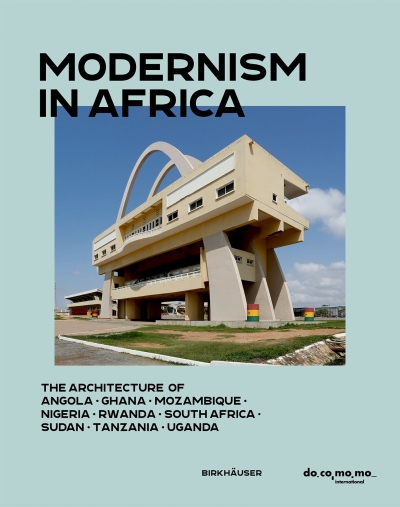
Cover Modernism in Africa

Modernism in Africa

The Architecture of Angola, Ghana, Mozambique, Nigeria, Rwanda, South Africa, Sudan, Tanzania, Uganda

Many African countries are home to extraordinary architecture that is virtually unknown. There are interpretations of Art Deco, International Style, Brutalism as well as of African vernacular architecture. Climate-responsive buildings with a fluidity of interior and exterior spaces play a large role. While many of these 20th century architects were of European origin, they were deeply influenced by their surroundings and found original, site-specific expressions, often in collaboration with African architects. A focus of the construction activities were educational buildings which played an important role for these young nations that mostly gained their independence in the 1960s. While some of the documented buildings have been restored, others are still awaiting reconstruction.


Docomomo International (Ed)
Modernism in Africa

The Architecture of Angola, Ghana, Mozambique, Nigeria, Rwanda, South Africa, Sudan, Tanzania, Uganda

Birkhäuser, 2024, 978-3-0356-2833-3
79,00 €