



















Direkt zum Inhalt

Warenkorb

  • gerade nicht auf Lager
    Felicity D. Scott

    Architecture or Techno-Utopia. Politics after Modernism

  • gerade nicht auf Lager
    Birgit Schneider

    Textiles Prozessieren

  • Bruno Latour

    Wir sind nie modern gewesen. Versuch einer Symmetrischen…

  • gerade nicht auf Lager
    Georges Canguilhem

    Wissenschaft, Technik, Leben. Beiträge zur historischen…

  • gerade nicht auf Lager
    Stuart Elden, Elizabeth Lebas, Eleonore…

    Henri Lefebvre. Key Writings

  • Laurence A. Rickels

    Ulrike Ottinger. Eine Autobiografie

  • N. John Habraken, Arnulf Lüchinger

    Die Träger und die Menschen. Das Ende des Massenwohnungsbau…

  • gerade nicht auf Lager
    Liz Kotz

    Words to Be Looked at. Language in 1960s Art

  • Guy Debord

    Comments on the Society of the Spectacle

  • Michel de Certeau

    Kunst des Handelns

  • gerade nicht auf Lager
    Jacques Ranciere

    Ist Kunst widerständig?

  • Alain Badiou

    Wofür steht der Name Sarkozy?

  • gerade nicht auf Lager
    Donna Haraway

    Die Neuerfindung der Natur. Primaten, Cyborgs und Frauen.

  • gerade nicht auf Lager
    Stefanie Schulte Strathaus, Florian…

    Wer sagt denn, dass Beton nicht brennt, hast Du’s probiert?

  • gerade nicht auf Lager
    Henri Lefebvre

    Writings on Cities

  • gerade nicht auf Lager
    Henri Lefebvre

    The Production of Space

  • Hiromasa Shirai, André Schmidt (Hg.)

    Big Bang Beijing. Urban Change in Beijing

  • gerade nicht auf Lager
    John F. C. Turner

    Housing by People. Towards Autonomy in Building…

  • Loretta Napoleoni

    Rogue Economics. Capitalism's New Reality

  • AD

    AD 174. Vol. 75. Nr. 2. Samantha Hardingham. The 1970'…

  • An Architektur

    An Architektur 18: Camp for Oppositional Architecture:…

  • Johan Frederik Hartle

    Der geöffnete Raum. Zur Politik der ästhetischen Form

  • An Architektur

    An Architektur 16-17

  • Vera Beyer, Jutta Voorhoeve, Anselm…

    Das Bild ist der König. Repräsentation nach Louis Marin

  • An Architektur

    An Architektur 15 / FFM 11: Europäische…

  • An Architektur

    An Architektur 14: Camp for Oppositional Architecture

  • An Architektur

    An Architektur 11-13: Theorie und Praxis der Kartografie

  • An Architektur

    An Architektur 10: Gemeinschaftsräume

  • An Architektur

    An Architektur 04-09: Krieg und die Produktion von Raum

  • IDEA Magazine

    IDEA 296. Books <preposition> graphic design

  • IDEA Magazine

    IDEA 293. Stanley Donwood / Vacances. DD-DDD / Dimensions…

  • gerade nicht auf Lager
    An Architektur

    An Architektur 01-03

  • Pro qm

    Gutschein / Voucher

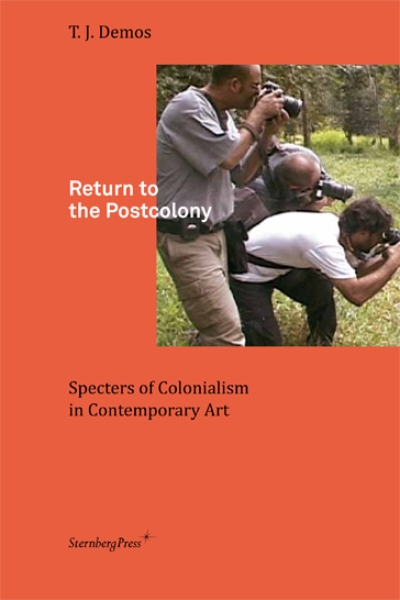
Return to the Postcolony

Specters of Colonialism in Contemporary Art
In the wake of failed states, growing economic and political inequality, and the ongoing US- and NATO-led wars for resources, security, and economic dominance worldwide, contemporary artists are revisiting former European colonies, considering past injustices as they haunt the living yet remain repressed in European consciousness. With great timeliness, projects by Sven Augustijnen, Vincent Meessen, Zarina Bhimji, Renzo Martens, and Pieter Hugo have emerged during the fiftieth anniversary of independence for many African countries, inspiring a kind of “reverse migration”—a return to the postcolony, which drives an ethico-political as well as aesthetic set of imperatives: to learn to live with ghosts, and to do so more justly.
T. J. Demos places contemporary art within the context of neoliberal globalization and what scholars have referred to as the “colonial present.” The analysis is complex and provocative, both for an understanding of the historical material as well as for the contemporary theoretical discourse. Return to the Postcolony is one of the most ambitious, intelligent, and readable texts on contemporary art related to the African context that I have read.
—Alexander Alberro, author of Conceptual Art and the Politics of Publicity
The specters of colonialism continue to haunt the current global order. Far removed from universalist and ultimately empty demands for a “global art history,” T. J. Demos uses particular cases to explore the false universality of “globalization” as we know it. This is art writing at its best: determinate and determined.
—Sven Lütticken, author of Idols of the Market: Modern Iconoclasm and the Fundamentalist Spectacle


T. J. Demos
Return to the Postcolony
Sternberg Press, 2013, 978-3-943365-42-9
gerade nicht auf Lager