







Direkt zum Inhalt

Warenkorb

  • gerade nicht auf Lager
    Donna Haraway

    Die Neuerfindung der Natur. Primaten, Cyborgs und Frauen.

  • gerade nicht auf Lager
    Stefanie Schulte Strathaus, Florian…

    Wer sagt denn, dass Beton nicht brennt, hast Du’s probiert?

  • gerade nicht auf Lager
    Henri Lefebvre

    Writings on Cities

  • Loretta Napoleoni

    Rogue Economics. Capitalism's New Reality

  • AD

    AD 174. Vol. 75. Nr. 2. Samantha Hardingham. The 1970'…

  • An Architektur

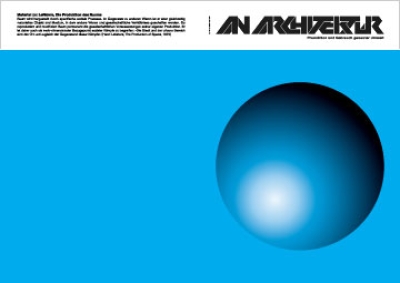
    An Architektur 18: Camp for Oppositional Architecture:…

  • Johan Frederik Hartle

    Der geöffnete Raum. Zur Politik der ästhetischen Form

  • An Architektur

    An Architektur 16-17

  • Vera Beyer, Jutta Voorhoeve, Anselm…

    Das Bild ist der König. Repräsentation nach Louis Marin

  • An Architektur

    An Architektur 15 / FFM 11: Europäische…

  • An Architektur

    An Architektur 14: Camp for Oppositional Architecture

  • An Architektur

    An Architektur 11-13: Theorie und Praxis der Kartografie

  • An Architektur

    An Architektur 10: Gemeinschaftsräume

  • An Architektur

    An Architektur 04-09: Krieg und die Produktion von Raum

  • IDEA Magazine

    IDEA 296. Books <preposition> graphic design

  • IDEA Magazine

    IDEA 293. Stanley Donwood / Vacances. DD-DDD / Dimensions…

  • gerade nicht auf Lager
    An Architektur

    An Architektur 01-03

  • Pro qm

    Gutschein / Voucher

  • Siegfried Kracauer

    Das Ornament der Masse. Essays

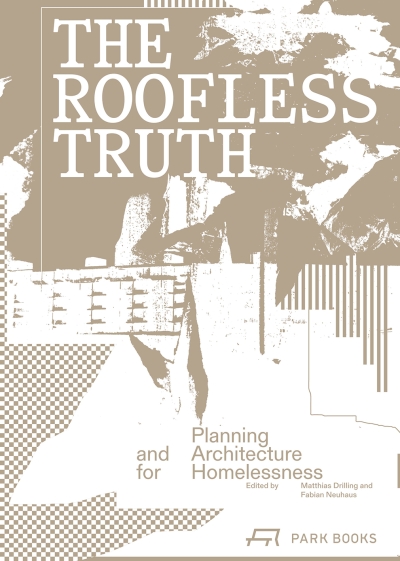
Cover The Roofless Truth. Planning and Architecture for Homelessness

The Roofless Truth. Planning and Architecture for Homelessness

Homelessness is one of the most pressing social challenges of our time, and is closely linked to issues of urban design and architecture. Homeless people are part of urban society and depend on accessible public spaces and urban infrastructure. Yet, in cities around the world, local governments use policies and urban planning to ward off street people, aiming at making them invisible in the cityscape and deliberately impeding certain forms of stay. Urban design always reflects power structures—it can exclude or open up avenues for participation.

The Roofless Truth brings together contributions by international researchers and practitioners from the fields of architecture, urban development and design, sociology, ethnology, social work, and education. It offers academic analyses and essays, field reports, and student proposals for interventions in public space, and features award-winning projects and initiatives in Canada, Germany, Iran, Switzerland, and the US.

The book highlights how public spaces should be designed to offer protection, dignity, and opportunities for homeless people, and to facilitate encounters and interaction. The featured examples impressively demonstrate that even the smallest spatial decision can determine inclusion or exclusion. The Roofless Truth paints a multifaceted picture of planning and design as a social practice beyond representation and prestige.


Matthias Drilling, Fabian Neuhaus (Hg)
The Roofless Truth. Planning and Architecture for Homelessness
Park Books, 2026, 978-3-03860-475-4
38,00 €