













Direkt zum Inhalt

Warenkorb

  • gerade nicht auf Lager
    Jacques Ranciere

    Ist Kunst widerständig?

  • Alain Badiou

    Wofür steht der Name Sarkozy?

  • gerade nicht auf Lager
    Donna Haraway

    Die Neuerfindung der Natur. Primaten, Cyborgs und Frauen.

  • gerade nicht auf Lager
    Stefanie Schulte Strathaus, Florian…

    Wer sagt denn, dass Beton nicht brennt, hast Du’s probiert?

  • gerade nicht auf Lager
    Henri Lefebvre

    Writings on Cities

  • gerade nicht auf Lager
    Henri Lefebvre

    The Production of Space

  • Hiromasa Shirai, André Schmidt (Hg.)

    Big Bang Beijing. Urban Change in Beijing

  • gerade nicht auf Lager
    John F. C. Turner

    Housing by People. Towards Autonomy in Building…

  • Loretta Napoleoni

    Rogue Economics. Capitalism's New Reality

  • AD

    AD 174. Vol. 75. Nr. 2. Samantha Hardingham. The 1970'…

  • An Architektur

    An Architektur 18: Camp for Oppositional Architecture:…

  • Johan Frederik Hartle

    Der geöffnete Raum. Zur Politik der ästhetischen Form

  • An Architektur

    An Architektur 16-17

  • Vera Beyer, Jutta Voorhoeve, Anselm…

    Das Bild ist der König. Repräsentation nach Louis Marin

  • An Architektur

    An Architektur 15 / FFM 11: Europäische…

  • An Architektur

    An Architektur 14: Camp for Oppositional Architecture

  • An Architektur

    An Architektur 11-13: Theorie und Praxis der Kartografie

  • An Architektur

    An Architektur 10: Gemeinschaftsräume

  • An Architektur

    An Architektur 04-09: Krieg und die Produktion von Raum

  • IDEA Magazine

    IDEA 296. Books <preposition> graphic design

  • IDEA Magazine

    IDEA 293. Stanley Donwood / Vacances. DD-DDD / Dimensions…

  • gerade nicht auf Lager
    An Architektur

    An Architektur 01-03

  • Pro qm

    Gutschein / Voucher

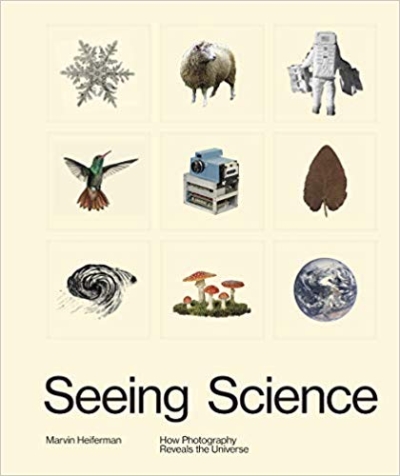
Seeing Science: How Photography Reveals the Universe

Seeing Science offers an insightful and reader-friendly collection of essays and pictures about photography’s role in visualizing science and building human knowledge—from micro to macro levels and everything in between.
Photography and science have long been intertwined, helping to shape the way we look at the world. Scientists use photography as a way to gather information, explore, and learn, but just as important, photography is also used to promote scientific advances and has long served as an interface between the sciences and the public. Our understanding of outer space depends on images sent to Earth from the Hubble Space Telescope, just as our understanding of our own bodies depends on X-rays. Images make visible what lies beyond human perception.
Science is less an edifice of facts than a process of discovery and inquiry. In this way, it is not dissimilar to art; artists have engaged with some of the same scientific principles, using photography to imagine the world differently and present us with new experiences and ways of seeing. This volume presents both perspectives exploring how science is made perceptible, featuring over three hundred images and sixty short texts. Together they engage readers in a timely exploration of the extent to which our knowledge is formed and transformed through our interactions with photographic imagery.


Marvin Heiferman
Seeing Science: How Photography Reveals the Universe
Aperture, 2019, 9781597114479
gerade nicht auf Lager