






























































Direkt zum Inhalt

Warenkorb

  • gerade nicht auf Lager
    Stefanie Schulte Strathaus, Florian…

    Wer sagt denn, dass Beton nicht brennt, hast Du’s probiert?

  • gerade nicht auf Lager
    Henri Lefebvre

    Writings on Cities

  • gerade nicht auf Lager
    Henri Lefebvre

    The Production of Space

  • Hiromasa Shirai, André Schmidt (Hg.)

    Big Bang Beijing. Urban Change in Beijing

  • gerade nicht auf Lager
    John F. C. Turner

    Housing by People. Towards Autonomy in Building…

  • Loretta Napoleoni

    Rogue Economics. Capitalism's New Reality

  • AD

    AD 174. Vol. 75. Nr. 2. Samantha Hardingham. The 1970'…

  • An Architektur

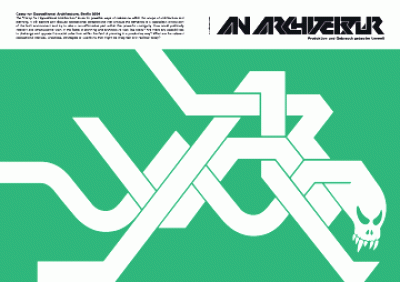
    An Architektur 18: Camp for Oppositional Architecture:…

  • Johan Frederik Hartle

    Der geöffnete Raum. Zur Politik der ästhetischen Form

  • An Architektur

    An Architektur 16-17

  • Vera Beyer, Jutta Voorhoeve, Anselm…

    Das Bild ist der König. Repräsentation nach Louis Marin

  • An Architektur

    An Architektur 15 / FFM 11: Europäische…

  • An Architektur

    An Architektur 14: Camp for Oppositional Architecture

  • An Architektur

    An Architektur 11-13: Theorie und Praxis der Kartografie

  • An Architektur

    An Architektur 10: Gemeinschaftsräume

  • An Architektur

    An Architektur 04-09: Krieg und die Produktion von Raum

  • IDEA Magazine

    IDEA 296. Books <preposition> graphic design

  • IDEA Magazine

    IDEA 293. Stanley Donwood / Vacances. DD-DDD / Dimensions…

  • gerade nicht auf Lager
    An Architektur

    An Architektur 01-03

  • Pro qm

    Gutschein / Voucher

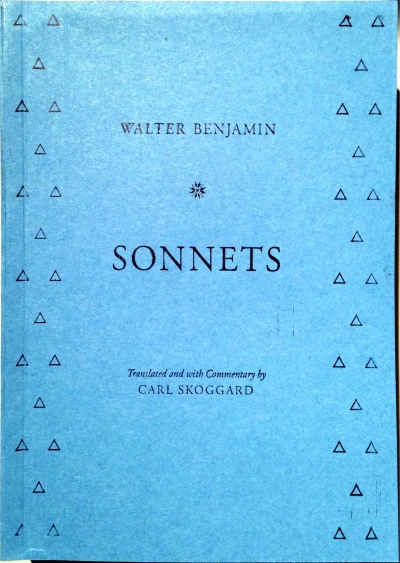
Sonnets

translated and with comments by Carl Skoggard
Walter Benjamin's sonnets written to mourn his friend Fritz Heinle constitute an important though little-known part of the German-Jewish philosopher's literary achievement and a unique contribution to the history of the German sonnet. Benjamin would add to their number for as much as a decade, having begun his project soon after the outbreak of World War I and the suicide of a special friend. Here, for the first time, readers of English are offered translations of all 73 "Heinle sonnets" along with the original German and line-by-line commentary. An introductory essay examines their biographical context as well as Benjamin's bold approach to sonnet writing. These poems weave the deeply personal together with his evolving religious and philosophical perspective in ways both mysterious and recongnizably Benjaminian—shedding new light on the emergence of the man and the thinker.


Walter Benjamin.
Sonnets
Publication Studio, 2015
gerade nicht auf Lager