































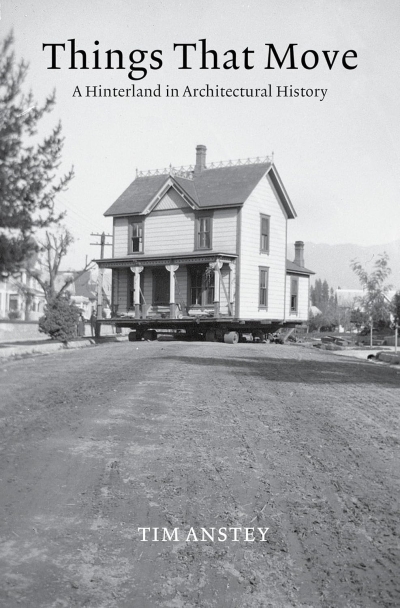
Things That Move. A Hinterland in Architectural History
A history of architecture, not as the art of what stays but of what changes and moves.
We tend to think of architecture as a practice in permanence, but what if we looked instead for an architecture of transience? In Things That Move, Tim Anstey does just that: rather than assuming that architecture is, at a certain level, stationary, he considers how architecture moves subjects (referring to its emotive potential in the experience it creates); how it moves objects (referring to how it choreographs bodies in motion); and how it is itself moved (referring to the mixture of materials, laws, affordances, and images that introduce movement into any architectural condition).
The first of the book’s three sections, “Cargoes,” highlights the mobile peripheries of architectural history through the eighteenth and nineteenth centuries. It asks what kinds of knowledge can be included under a discussion of something called architecture, noting the connections between discourses of the lithe and the technical, on the one hand, and those associated with the production of monumental, static compositions on the other. The second section, “Dispatches,” reinterprets early architectural theory by examining the Renaissance ideal of decorum, the nature of the architectural work, and the ways in which architects are constituted as authors. Lastly, “Vehicles” considers building in terms of literal and metaphorical movement, using two cases from the twentieth century that investigate the relationship between architecture and cultural memory.
Using a broadly forensic approach to connect details in otherwise disparate cases, Things That Move is a breathtakingly capacious architectural account that will change the way readers understand buildings, their becoming, and their significance.