
















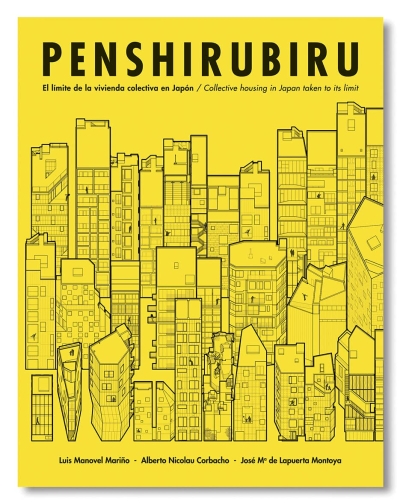
Penshirubiru. Collective housing in Japan taken to its limit. El limite de la vivienda colectiva en Japón
This book explores a unique architectural and urban phenomenon that redefines the way we understand domesticity and urban living in contemporary cities.
Penshirubiru-literally “pencil buildings”-rise as slender habitable towers on minimal plots of land, challenging both the limits of space and the traditional conventions of residential architecture.
Through researched text and in-depth graphic analysis, the authors immerse us in the historical, social, and cultural roots that gave rise to these buildings in Japan. From the chaotic density of Tokyo to the mix of uses that characterizes Japanese cities, the penshirubiru reflect an innovative and logical response to contemporary challenges such as the individualization of society, the downsizing of households, and the high price of urban land.
This book not only documents the physical and constructive characteristics of these buildings, but also offers a critical reflection on how architecture can adapt to extreme realities without losing its capacity to excite. In its pages we discover examples that combine functionality and beauty, where spatial limitation is transformed into a creative opportunity.
With texts by Luis Manovel Mariño, Alberto Nicolau Corbacho, and José María de Lapuerta Montoya, this work is a window on the present and future of urban housing, not only in Japan, but also as a possible inspiration for other global contexts. A must-read for architects, urban planners, and anyone interested in understanding how design can respond to the changing needs of our cities.