
























































































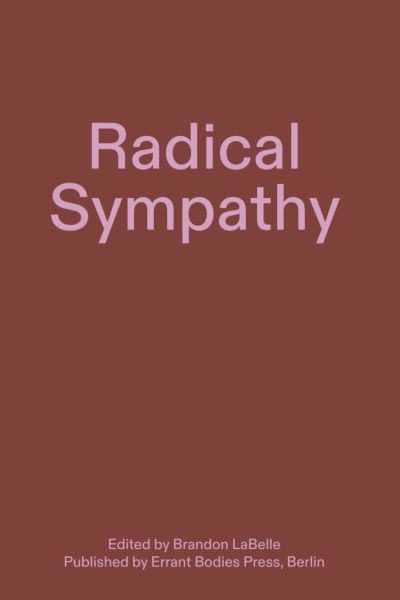
Radical Sympathy
Contributions by Anastasia A Khodyreva, Milla Tiainen, Taru Leppänen & Katve-Kaisa Kontturi, Margarida Mendes, Achille Mbembe, Cecilie Sachs Olsen, Michelle-Marie Letelier, Valeria Graziano, Tomislav Medak, Marcell Mars (Pirate Care), Lilia Mestre
Questions of interdependency and care have gained broader urgency within today’s planetary environment. From the pressing need to work at post-carbon futures to the challenges surrounding our covid-19 realities, understandings of care-work and co-existence require ever-greater imagination and creative engagement. As cultural communities reorient their practices and educational institutions test out other methods in the context of the pandemic, a new sense for solidarity and critical hope are gaining traction. This includes ways of attending to the politics of care, the systems of neoliberal extraction and their toxic projects, and the uneven power relations through which solidarity must work.
The publication, Radical Sympathy, gathers a diversity of voices and perspectives with the aim of capturing methods and expressions of care and communal effort, as well as theoretical reflections on sympathy as a position of caring-for. While sympathy may carry connotations of charity, as that which acts from a distance, the publication underscores sympathy as what also enables forms of action and imagination. As Stephen Darwall argues, sympathy is a feeling or emotion that responds to an apparent threat or obstacle to another’s well-being. In contrast to empathy, as feeling what others feel, sympathy is responsive and the basis for action. Jane Bennett further argues in Influx and Efflux how sympathy may move from personal compassion to impersonal force, from scenes of familiarity and proximity to broader relations and recognition. Sympathy, for Bennett, is understood as “currents” that exist in and outside of bodies, that flow as affective and resonant forces, and that figure across human and more-than-human, bodily and technical worlds. It is by way of sympathy that interconnectivity and interdependency are felt as well as made categorical, articulating a position of concern and collaboration especially beyond one’s immediate relational circles.
From interpersonal care to rhythms of collaboration and resistance, the publication offers reflections on how personal compassion and impersonal force can be deployed, lending to a disposition of solidarity and the crafting of unlikely companionships.