Planetary Urbanization in Question - new explorations from the Urban Theory Lab
Book launch and discussion with Neil Brenner, Nikos Katsikis, Grga Bašić (Urban Theory Lab, University Chicago), Anke Hagemann and Philipp Misselwitz (Habitat Unit, TU Berlin), Clemens Finkelstein (LMU Munich) and Orit Halpern (TU Dresden)
How can we decipher the geographies of planetary urbanization in an era of climate breakdown? What role do non-city spaces play in this process? As cities increasingly depend on distant agricultural regions, mining zones, energy corridors, and large-scale logistical networks for their metabolic needs, the conceptual and representational tools through which we apprehend the urban condition must be fundamentally reimagined. Two new books by researchers in the Urban Theory Lab (UTL) approach these challenges by combining new ideas on critical urban theory, analyses of capitalist geohistory, and various forms of experimental cartography and geovisualization.
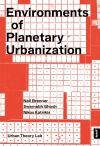
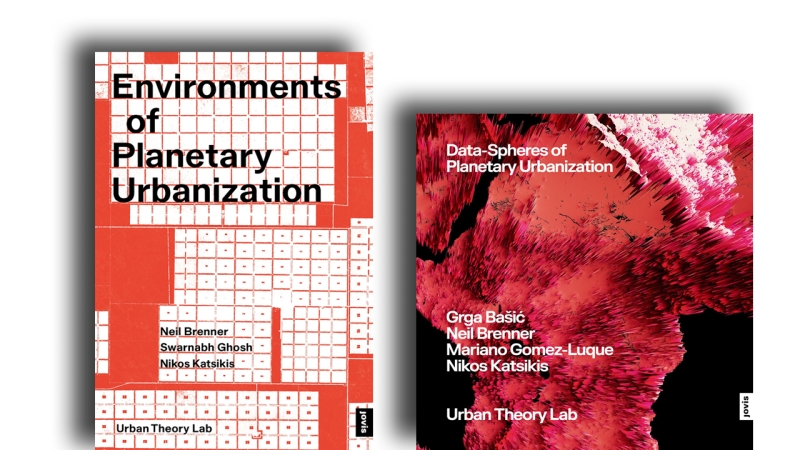
Environments of Planetary Urbanization. Neil Brenner, Swarnabh Ghosh, Nikos Katsikis (JOVIS, 2025) What role do spaces beyond the city play in urbanization? How have such spaces been transformed during the geohistory of capitalism? This volume brings together texts collaboratively produced by three researchers in the Urban Theory Lab to address these questions. Planetary urbanization is understood here not only with reference to the global expansion and proliferation of cities, but as an evolving web of metabolic relations between cities and the diverse operational landscapes that support them across the earth. Through studies of operational landscapes in various regions of the world and critical analyses of inherited approaches to urban theory, the authors portray capitalist urbanization as a metabolic monstrosity that degrades the biospheric foundations of both human and nonhuman life.
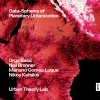
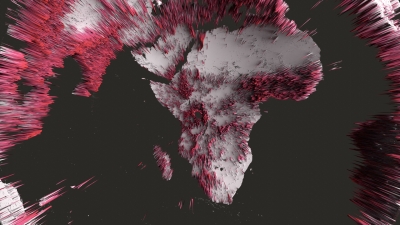
Data-Spheres of Planetary Urbanization. Grga Bašić, Neil Brenner, Mariano Gomez-Luque, Nikos Katsikis (JOVIS, 2026) How can we map the urbanization of the planet in an era of climate breakdown? The Urban Theory Lab’s Data-Spheres of Planetary Urbanization confronts this question by assembling a series of experimental visualizations of the worldwide urban fabric. This book reverses the mainstream, city-centric perspective on urbanization, showing, instead, that the world of contemporary urbanization encompasses much of the planet, including apparently remote areas, wildlands, and oceans. Cities are not only producers of value, but also entropic black holes that consume surpluses produced elsewhere and project waste back into the planetary biosphere. Non-city spaces are, correspondingly, the metabolic bases of planetary urbanization.
The book launch is part of a two-day workshop convened by the Urban Theory Lab (University of Chicago) and the Habitat Unit (TU Berlin). Funded through the UChicago-Berlin University Alliance Workshop Grants.